
After the market digests the interest rate cut expectations, how should we navigate the direction of risk assets?

Original Article Title: "This Thursday Morning, the Direction of Risk Assets Was Not Determined by the Rate Cut Itself"
Original Article Author: David, DeepTech TechFlow
This Thursday (Beijing time), the Federal Reserve will announce its last interest rate decision of the year. The market expectations are very consistent:
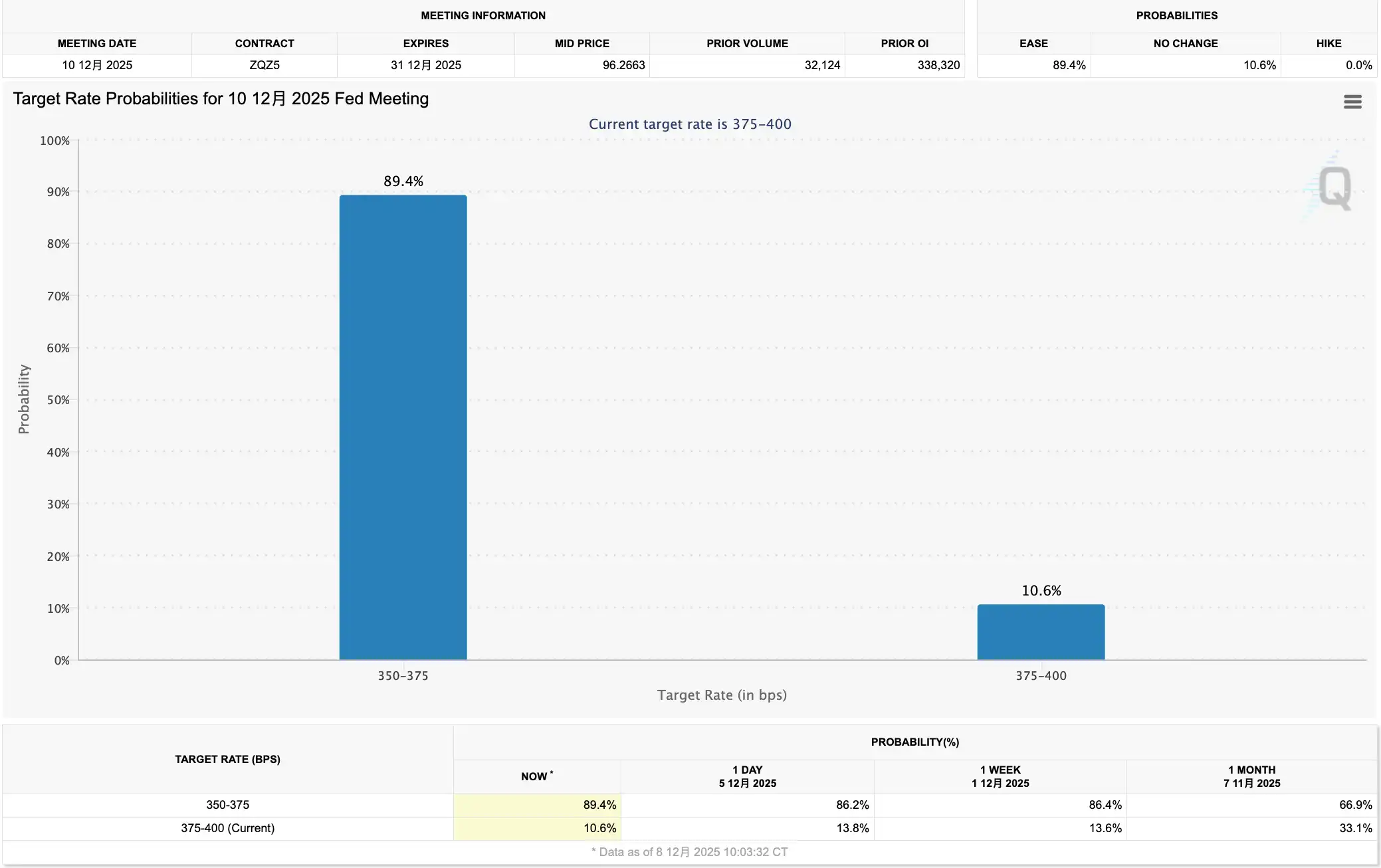
According to CME FedWatch data, the probability of a 25 basis point rate cut is over 85%.
If implemented, this will be the third consecutive rate cut since September, bringing the federal funds rate to the 3.5%-3.75% range.
For cryptocurrency investors accustomed to the "Rate Cut = Good News" narrative, this sounds like good news.
However, the problem is that when everyone expects a rate cut, the rate cut itself is no longer the driving factor of the market.
The financial market is an expectation machine. Prices reflect not "what has happened" but "what has happened relative to expectations".
An 85% probability means that a rate cut has already been fully priced in; when announced early Thursday morning, unless there is an unexpected development, the market will not react much.
So what is the real variable?
The Federal Reserve's Outlook for Next Year. A 25 basis point cut is mostly a certainty, but how long the rate-cutting cycle will last, how many more cuts in 2025, these are the things the market is truly playing for.
Early Thursday morning, the Federal Reserve will simultaneously update their forecast for the future rate path, and this forecast often has more impact on the market direction than the rate cut decision itself.
But this time, there is an additional issue, which is that the Federal Reserve itself may not have a clear view.
The reason is that from October 1 to November 12, the U.S. federal government was shut down for 43 days. During this period, the statistical department was on hold, leading to the cancellation of the October CPI release, and the November CPI being postponed to December 18, a full week later than this week's FOMC meeting.
This means that Fed members are lacking inflation data from the past two months when discussing the rate outlook.
When decision-makers themselves are groping in the dark, the guidance they provide will be more ambiguous, and ambiguity often means a wider range of market volatility.
Let's first take a look at this week's timeline:
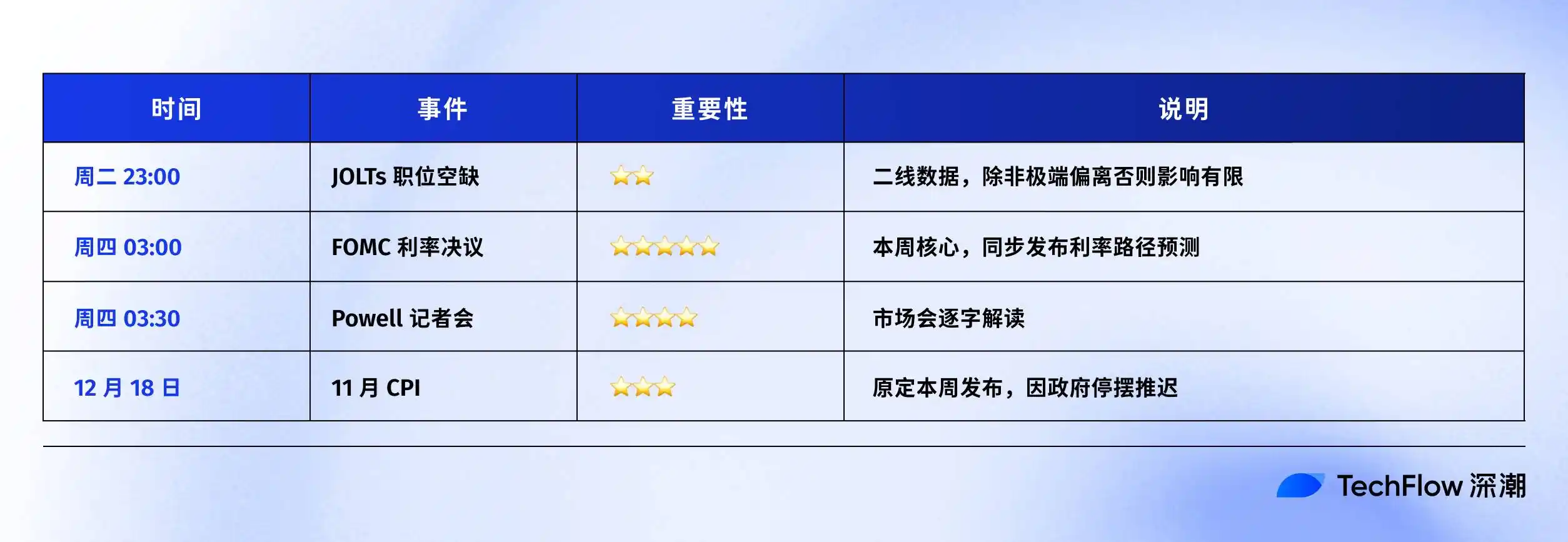
We can specifically analyze what kind of signals the Fed may give and how the market would react to each.
Game Expectations for Next Year
After each FOMC meeting, the Fed releases an "Summary of Economic Projections."
There is a chart inside that shows all Fed committee members' expectations for future interest rates.
Each member plots a point to indicate where they think the year-end rate should be. Because it looks like a bunch of scattered dots, the market commonly calls it a "dot plot." You can find the original dot plot for each meeting on the Federal Reserve website.
The following is the dot plot released at the September 17 FOMC meeting.
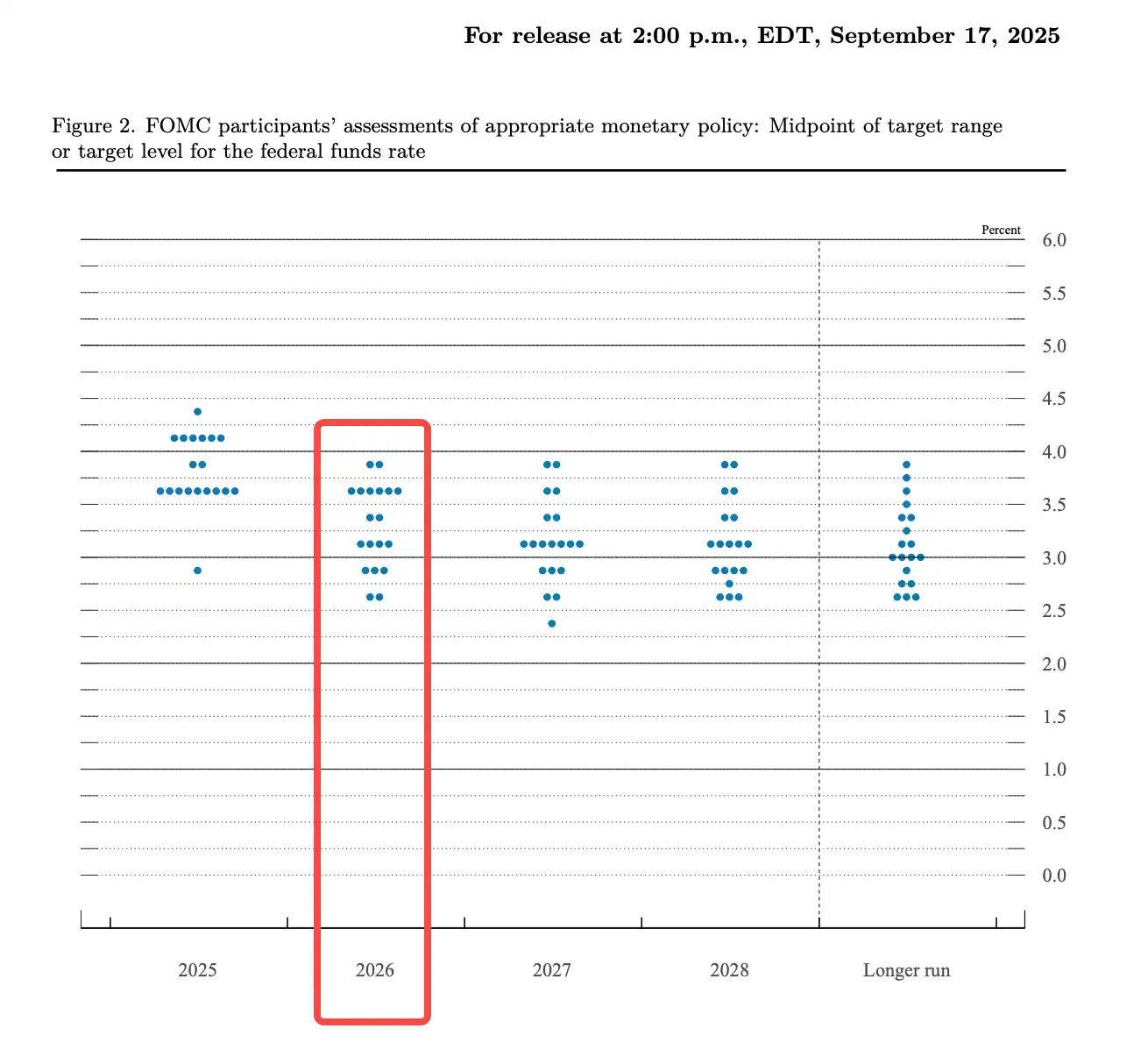
It shows the internal divisions and consensus within the Fed. If the dots are clustered together, it indicates that committee members are in agreement, and the policy path is relatively clear;
If the dots are widely dispersed, it indicates internal disagreement, and the future is full of variables.
For the crypto market, uncertainty itself is a risk factor. It will suppress risk appetite, causing funds to lean towards a wait-and-see approach rather than entering the market.
From the chart, you can see that the dots in the 2025 column are mainly concentrated in two areas: around 3.5%-3.625%, there are about 8-9 dots, and around 3.75%-4.0%, there are also 7-8 dots. This indicates that the committee is divided into two camps:
One camp believes there should be 1-2 more cuts this year, while the other camp believes there should be a pause or only one more cut. The median is around 3.6%, meaning the majority's baseline expectation is to cut rates twice in 2025 (including this week's).
Looking at 2026, the divisions among Fed members are even greater.
The current rate is 3.75%-4.00%. If it drops to around 3.4% by the end of next year, it means there would be only 1-2 cuts throughout the year. But from the chart, some members believe it should drop to 2.5% (equivalent to 4-5 cuts), while others believe it should stay at 4.0% (no cuts at all).
Within the same committee, the most hawkish and most dovish expectations are 6 rate cuts apart. This is a "highly divided" Federal Reserve committee.
This division in itself is a signal.
If the Federal Reserve cannot reach a consensus internally, the market will naturally vote with its feet. Currently, traders' bets are more aggressive than the official guidance. CME FedWatch shows that the market is pricing in 2-3 rate cuts by 2026, while the median of the official dot plot only shows 1 cut.
Therefore, this Thursday's FOMC meeting is to some extent a "showdown" between the Fed and the market, whether the Fed will align with the market or stick to its own pace.
Three Scenarios, Three Reactions
Based on the current information, there are roughly three possible outcomes for this week's FOMC meeting.
1. The most likely scenario is "as expected": a 25bp rate cut, the dot plot maintaining the guidance from the September meeting, Powell repeatedly emphasizing "data dependency" in the press conference, without giving a clear direction.
In this scenario, the market will not experience significant fluctuations. Since the rate cut is already priced in and the guidance remains unchanged, there is a lack of new trading signals. The crypto market will likely follow a minor oscillation in the stock market before returning to its previous trend.
This is also the benchmark expectation of most Wall Street institutions, including recent research reports from Goldman Sachs and Raymond James pointing in this direction.
2. The next possible scenario is "dovish-leaning": a 25bp rate cut, but the dot plot indicates the possibility of 2 or more cuts by 2026, with Powell's language leaning towards dovishness, emphasizing that the labor market risk is greater than the inflation risk.
This is equivalent to the Fed aligning with market expectations, confirming a loose path. A weaker dollar will boost dollar-denominated assets, while improving liquidity expectations will uplift market sentiment. BTC and ETH may follow the stock market's rebound, with the former likely testing recent highs.
3. A less probable but not dismissible scenario is "hawkish-leaning": despite a 25bp rate cut, Powell emphasizes inflation stickiness, hinting at limited rate-cutting space next year; or there are multiple dissenting votes, showing internal resistance to further easing.
This is like telling the market "you've expected too much," leading to a stronger dollar, tightening liquidity expectations, and pressure on risk assets. The crypto market may face a short-term correction, especially high-beta altcoins.
However, if it is just a matter of hawkish wording rather than a substantive policy shift, the decline is often limited, and it may even become a buying opportunity.
Normally, the Fed would adjust the dot plot based on the latest data. But this time, they missed two months of CPI due to the government shutdown and could only rely on incomplete information to make a judgment.
This has several chain reactions. First, the reference value of the dot plot itself is discounted; the members themselves are unsure, so the plotted points may be more scattered.
Second, the weight of Powell's press conference will be higher, and the market will look for directional cues in every word he says. If the tendency shown in the dot plot is inconsistent with Powell's tone, the market will be more confused, and volatility may increase.
For crypto investors, this means that the market conditions early Thursday morning may be more unpredictable than usual.
Instead of betting on a direction, it's better to focus on the volatility itself. When uncertainty rises, controlling position size is more important than betting on price movements.
The Job Openings Data Tonight Isn't as Important as You Think
We've discussed Thursday's FOMC so far, but tonight (Tuesday 23:00 Beijing time) there is another data release: JOLTs.
Occasionally, some people on social media may make it sound very important, like "quietly determining liquidity trends" and so on. But truth be told, JOLTs don't carry much weight in macroeconomic data. If you're short on time, focusing on Thursday's FOMC is enough;
If you want to learn more about the labor market background, you can continue reading.
JOLTs stands for Job Openings and Labor Turnover Survey, conducted monthly by the U.S. Bureau of Labor Statistics (BLS). It surveys how many job positions are open in U.S. businesses, how many people are being hired, and how many people are leaving their jobs.
The most closely watched metric is "job openings": the higher the number, the stronger the demand for hiring in businesses, and the tighter the labor market.
During the peak of 2022, this number exceeded 12 million, indicating a frenzy of hiring, rapid wage increases, and Fed concerns about inflationary pressures. Now, this number has fallen back to around 7.2 million, basically returning to pre-pandemic normal levels.
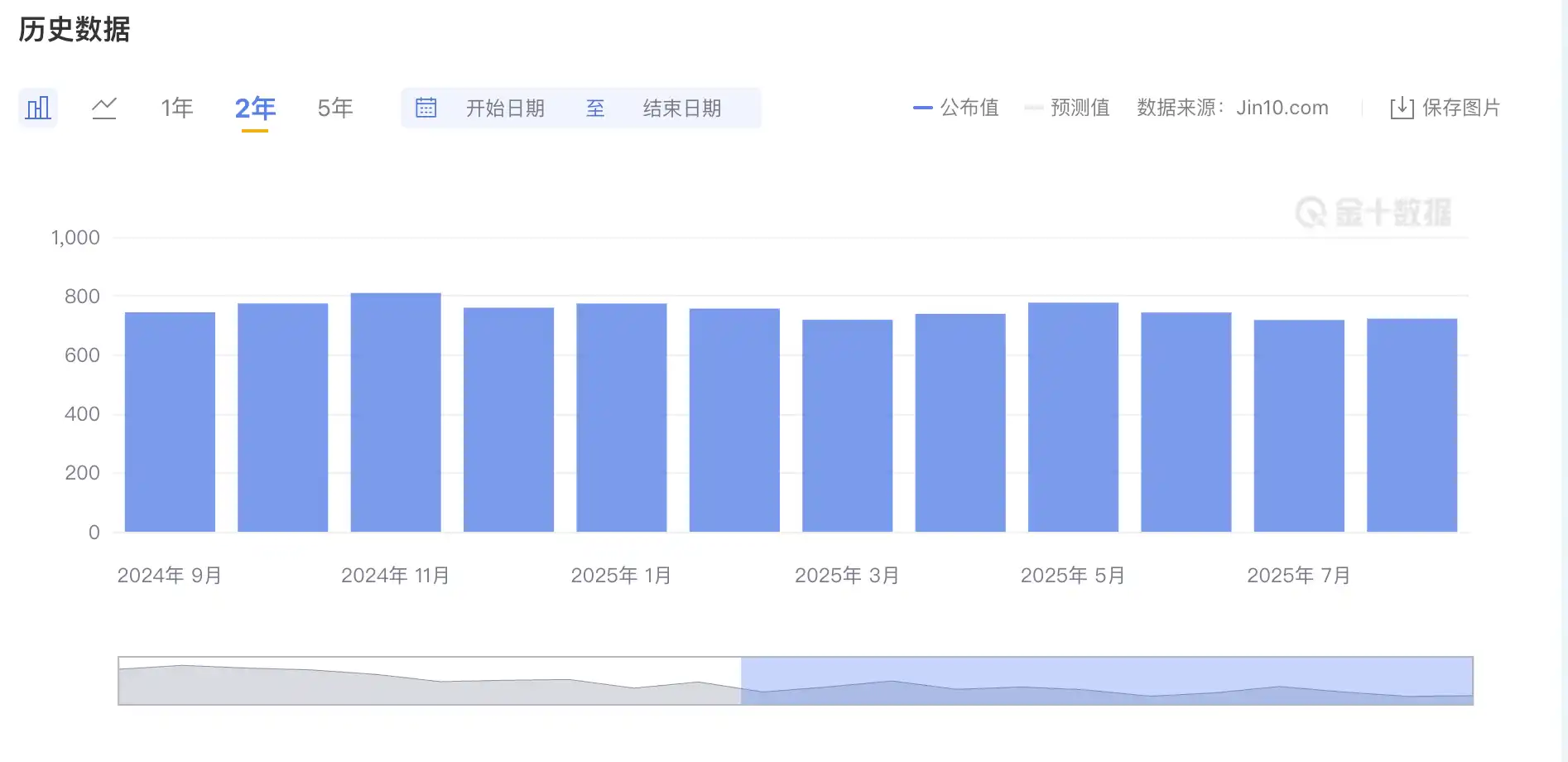
Image Source: Golden Finance Data
Why might the importance of this data be overestimated?
First, JOLTS is a lagging indicator. The data released today is for October, but it is now December. The market pays more attention to more timely data, such as weekly initial jobless claims and the monthly nonfarm payroll report released at the beginning of each month.
Second, the expected job openings of around 7.1 million are not considered "overheated." Some analysts have pointed out that the ratio of job openings to the unemployed fell below 1.0 in August, meaning there is now less than one job opening for every unemployed person.
This is completely different from the situation in 2022 where "one unemployed person corresponds to two job openings." The narrative of a "hot" labor market is actually outdated.
According to forecasts from LinkUp and Wells Fargo, the October JOLTS data to be released tonight is likely to be around 7.13-7.14 million, with little change from the previous 7.2 million.
If the data meets expectations, the market will have little reaction; it will simply confirm the existing narrative of the "labor market continuing to slowly cool down" and will not change anyone's expectations of the Fed.
Tonight's data is more like an "appetizer" before the FOMC meeting, and the real main course will be served in the early hours of Thursday.
How Will My BTC Behave?
The previous chapters have discussed macro data, but you may be more concerned about one question: How will all this affect my BTC and ETH holdings?
In summary, it will have an impact, but it's not as simple as "rate cut = rise."
The Fed's interest rate decisions affect the cryptocurrency market through several channels.
The first is the U.S. Dollar. Rate cuts mean a decrease in the returns of dollar-denominated assets, and funds will look for other options. When the dollar weakens, dollar-denominated assets (including BTC) often perform better.
The second is liquidity. In a low-rate environment, the cost of borrowing is low, there is more money in the market, and some of it flows into risk assets. The bull market of 2020-2021 was to a large extent the result of the Fed's unlimited quantitative easing.
The third is risk appetite. When the Fed sends a dovish signal, investors are more willing to take on risk, and funds flow from bonds and money market funds to stocks and cryptocurrencies; conversely, a hawkish signal will cause funds to flow back into safe assets.
These three channels together form the transmission chain of "Fed Policy → Dollar/Liquidity → Risk Appetite → Crypto Assets".
In theory, BTC now has two popular identities: "digital gold" or "risk asset".
If it is digital gold, it should behave like gold, rising in market panic and being negatively correlated with the stock market. If it is a risk asset, it should rise and fall with the Nasdaq, performing well in loose liquidity.
In reality, in the past few years, BTC has been more like the latter.
According to CME's research, starting from 2020, BTC's correlation with the Nasdaq 100 has jumped from close to zero to around 0.4, sometimes even exceeding 0.7. The Kobeissi Letter recently pointed out that BTC's 30-day correlation once reached 0.8, the highest level since 2022.
But recently, an interesting phenomenon has emerged. According to CoinDesk's report, over the past 20 days, the correlation between BTC and the Nasdaq has dropped to -0.43, showing a clear negative correlation.
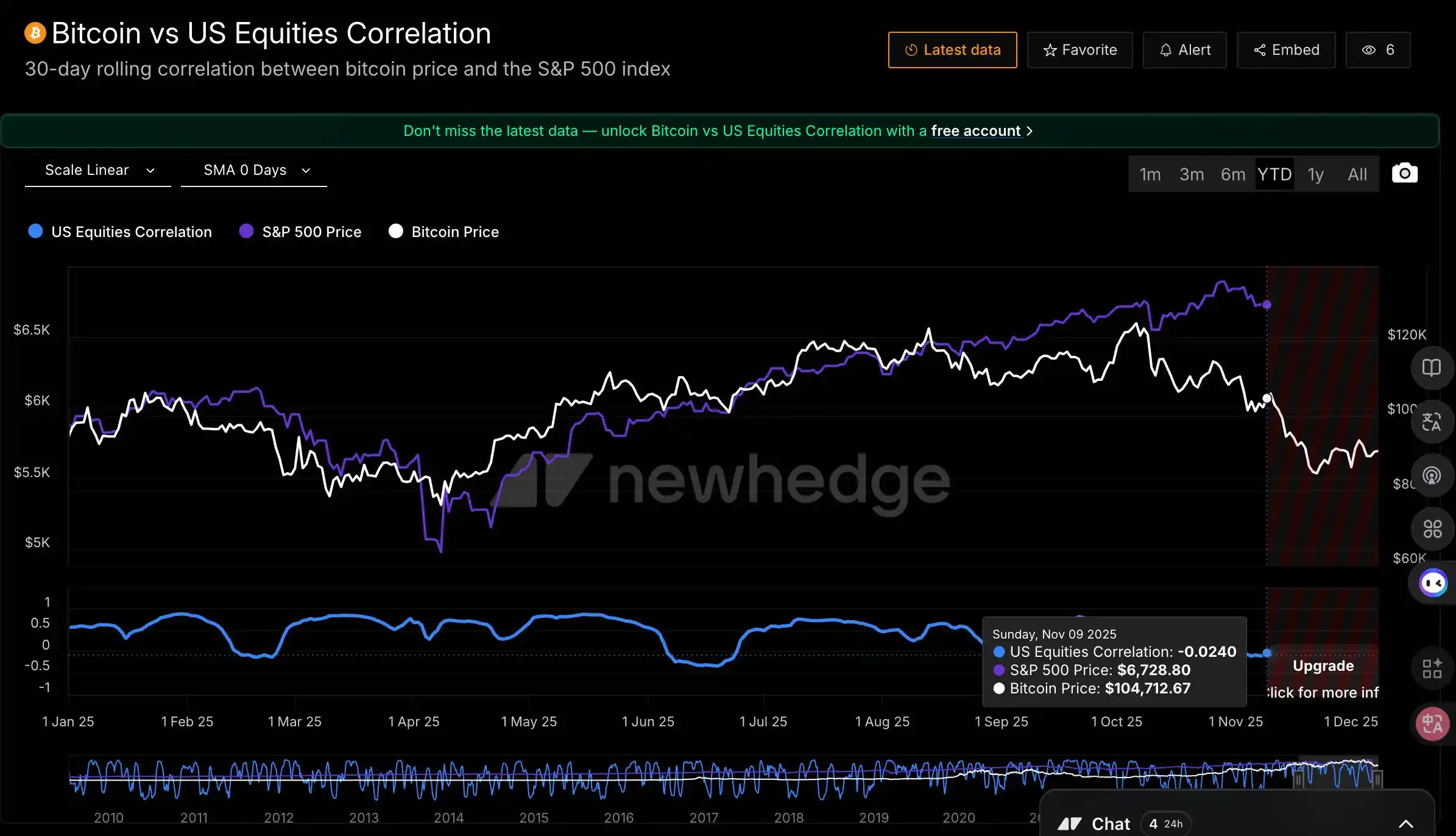
Data Source: https://newhedge.io/
The Nasdaq is only 2% away from its all-time high, while BTC has dropped 27% from its October peak.
Market maker Wintermute has an explanation for this: BTC is currently exhibiting "negative skewness," falling more when the stock market falls and responding sluggishly when the stock market rises. In their words, BTC "exhibits high Beta in the wrong direction only."
What does this mean?
If the FOMC releases a dovish signal this week and the U.S. stock market rises, BTC may not necessarily rebound in sync; but if a hawkish signal is released and the U.S. stock market falls, BTC may drop even further. This is an asymmetric risk structure.
Summary
After all that discussion, here is a framework for ongoing tracking.
What to Watch This Week (Dec 9-12)
The key focus will be the FOMC meeting early Thursday. Specifically, look out for three things: any changes in the dot plot, especially the median rate expectation for 2026, Powell's press conference tone leaning dovish or hawkish, and whether there are multiple dissenting votes.
What to Watch in Mid to Late December
On Dec 18, November's CPI will be released. If inflation data bounces back, the market may reprice expectations of rate cuts next year, challenging the Fed's "continued accommodation" narrative.
What to Watch in Q1 2026
Firstly, keep an eye on changes in the Fed chairmanship. Powell's term ends in May 2026.
Secondly, monitor the ongoing impact of Trump's policies. Further escalation of tariff policies could continue to raise inflation expectations, squeezing the Fed's room for maneuver.
Additionally, stay alert for any signs of accelerated deterioration in the labor market. If layoff figures begin to rise, the Fed may be forced to cut rates faster, setting the stage for a different scenario.
You may also like

Japan’s Three Megabanks Plan Joint Stablecoin Issuance in Fiscal 2026
MUFG, SMBC, and Mizuho reportedly plan to jointly issue fiat-pegged stablecoins in fiscal 2026, signaling Japan’s growing push into bank-led digital payment infrastructure.

Humanity Discloses H Token Dual-Chain Attack Details, With Losses on Ethereum and BSC Exceeding $36 Million
Humanity said the H token attack across Ethereum and BSC caused more than $36 million in losses after leaked ProxyAdmin keys enabled malicious contract upgrades and token minting.

White House Discusses CLARITY Act With Law Enforcement Ahead of Senate Vote
The White House discussed the CLARITY Act with law enforcement ahead of a Senate vote, focusing on illicit finance risks and developer protections.

$75 billion in foreign capital has fled, and South Korean retail investors have absorbed it all using leverage

Bitcoin Trading Guide 2026: Strategies for Experienced Traders

What Is XAUT and PAXG? Why Tokenized Gold Is Booming in 2026

Cryptocurrency CEXs are flocking to sell US stocks, and traditional brokerages are facing an "uninvited guest."

Will the SpaceX IPO Hurt Bitcoin? Here's What Traders Are Watching
Foreign selling in the South Korean stock market accelerates, with cumulative net sales reportedly reaching $75 billion this year
On June 9, The Kobeissi Letter, citing Goldman Sachs data, reported that global investors are selling South Korean stocks at an unusually rapid pace. In the latest trading session, foreign investors sold about $801 million worth of Kospi constituent stocks again; total foreign outflows last week reached about $10 billion, and the market has been in net foreign selling on nearly every trading day over the past month. According to the data cited in the report, foreign investors have sold about $75 billion worth of South Korean stocks so far this year. Meanwhile, South Korean retail and institutional investors together recorded roughly $69 billion in net buying over the same period, suggesting that the market’s main buying support has come from domestic capital rather than returning overseas funds. The information currently disclosed still mainly comes from The Kobeissi Letter’s retelling and Goldman Sachs data summaries, while public details on the statistical period and the specific definition of “selling” remain relatively limited.

Fortune Warns of Strategy’s Financing Structure Risks as Bitcoin Premium Narrows
Fortune warned that Strategy’s Bitcoin treasury model faces growing financing risks as MSTR’s net asset premium narrows and preferred stock dividend pressure increases.

Ferrari Challenge Le Mans: Carl Moon to Dominate in WEEX Livery

Sahara AI Responds to SAHARA’s Sharp Drop: No Contract or Product Security Issues Found, Internal Investigation Underway
Sahara AI responded to SAHARA’s 60% price drop, saying no token contract or product security issues have been found and an internal investigation is underway.

WEEX Deposit/Withdrawal Dynamic Island: Your Asset Status, Always in Sight
Scaling Crypto Derivatives: The Digital Asset Infrastructure Behind High-Volume Trading
In the fast-moving digital asset ecosystem, derivatives platforms face an extreme architectural test. High-leverage futures markets demand more than just standard security—they require absolute operational precision, zero-latency matching engines, and ironclad structural scalability, all while navigating intense market volatility.
As global platforms scale to meet these demands, the industry is shifting away from rigid, monolithic setups toward a more agile, "decoupled" infrastructure philosophy.
The Blueprint for High-Volume Copy TradingFor elite global exchanges like WEEX (founded in 2018), this architectural choice becomes critical when scaling high-volume retail features like social copy trading. When thousands of users automatically mirror the real-time strategies of elite traders simultaneously, it triggers sudden, monumental spikes in concurrent transactional volume.
To prevent execution latency or settlement bottlenecks during these peak volatility events, a platform's primary engine must remain entirely dedicated to risk management, copy-trade synchronization, and order matching.
The Architectural Rule: New-generation platforms must separate front-end user execution engines from heavy backend infrastructural overhead to eliminate operational friction.
By separating these layers, platforms can maintain complete sovereignty over their trading environments and user experiences while strategically aligning with institutional-grade infrastructure ecosystems. This strategic framework allows modern exchanges to leverage advanced Digital Asset Custody infrastructure such as Cobo’s behind the scenes, ensuring that backend wallet management scales elastically alongside trading spikes.
Capitalizing on Market Momentum and 400× LeverageIn a derivatives arena where platforms offer up to 400× leverage on perpetual contracts, capital efficiency and market agility are core business metrics. To capture market momentum, an exchange needs the ability to rapidly expand its asset offerings, supporting everything from legacy crypto assets to sudden, trending altcoins across a massive library of trading pairs.
Adopting a flexible, scalable Wallet-as-a-Service (WaaS) solution such as Cobo’s could completely rewrite the development timeline for high-growth exchanges. Instead of spending months of engineering capital building out custom backend wallet architectures for every new blockchain network, platforms can deploy localized infrastructure in days.
This agility allows platforms to instantly scale their listings to over a thousand trading pairs without compromising security or delaying time-to-market. It mirrors the exact operational advantages seen during high-velocity market events, similar to how advanced wallet infrastructure empowers platforms during sudden asset surges; allowing exchanges to pass that speed and liquidity directly to their global user base.
A Mature Foundation for GrowthThe synergy between trusted infrastructure ecosystems and global trading platforms represents the natural evolution of a maturing crypto market. As WEEX continues to scale its global spot and derivatives offerings for over 6 million users, adopting robust backend paradigms proves that platforms no longer have to compromise between cutting-edge trading velocity and uncompromised structural security.

Morning Report | BitMine increased its holdings by 126,971 ETH last week; trader Eugene announced his exit from the crypto market

Wang Chuan: How can one not feel anxious after the neighbor Old Wang made thirty times profit by investing in storage stocks? (Seven) - A quarter-century cycle

Get Paid to Onboard? Try WEEX’s New Homepage with Rewards for Registration, Deposit & Trade
WEEX Custom Layout: Build Your Perfect Trading Workspace in Seconds
Japan’s Three Megabanks Plan Joint Stablecoin Issuance in Fiscal 2026
MUFG, SMBC, and Mizuho reportedly plan to jointly issue fiat-pegged stablecoins in fiscal 2026, signaling Japan’s growing push into bank-led digital payment infrastructure.
Humanity Discloses H Token Dual-Chain Attack Details, With Losses on Ethereum and BSC Exceeding $36 Million
Humanity said the H token attack across Ethereum and BSC caused more than $36 million in losses after leaked ProxyAdmin keys enabled malicious contract upgrades and token minting.
White House Discusses CLARITY Act With Law Enforcement Ahead of Senate Vote
The White House discussed the CLARITY Act with law enforcement ahead of a Senate vote, focusing on illicit finance risks and developer protections.
$75 billion in foreign capital has fled, and South Korean retail investors have absorbed it all using leverage
Bitcoin Trading Guide 2026: Strategies for Experienced Traders
What Is XAUT and PAXG? Why Tokenized Gold Is Booming in 2026


