
BRC20 Ecosystem Revitalization? A New Dawn or an Illusion




Original Article Title: "BRC20 Ecological Recovery? A New Prelude or an Illusion"
Original Article Author: ChandlerZ, Foresight News
On February 24, after a long period of low-level operation, Bitcoin on-chain Gas fees experienced a significant increase, rising from an average of 1-2 satoshis/byte to over 12 satoshis/byte for high priority transactions. A few weeks ago, the Bitcoin mempool was fully cleared for the first time in nearly two years, but the number of unconfirmed transactions has since risen back to over 100,000.
According to Geniidata's data monitoring, in the past 24 hours, on-chain minting activity has shown a highly concentrated feature, mainly focusing on the MASK project.
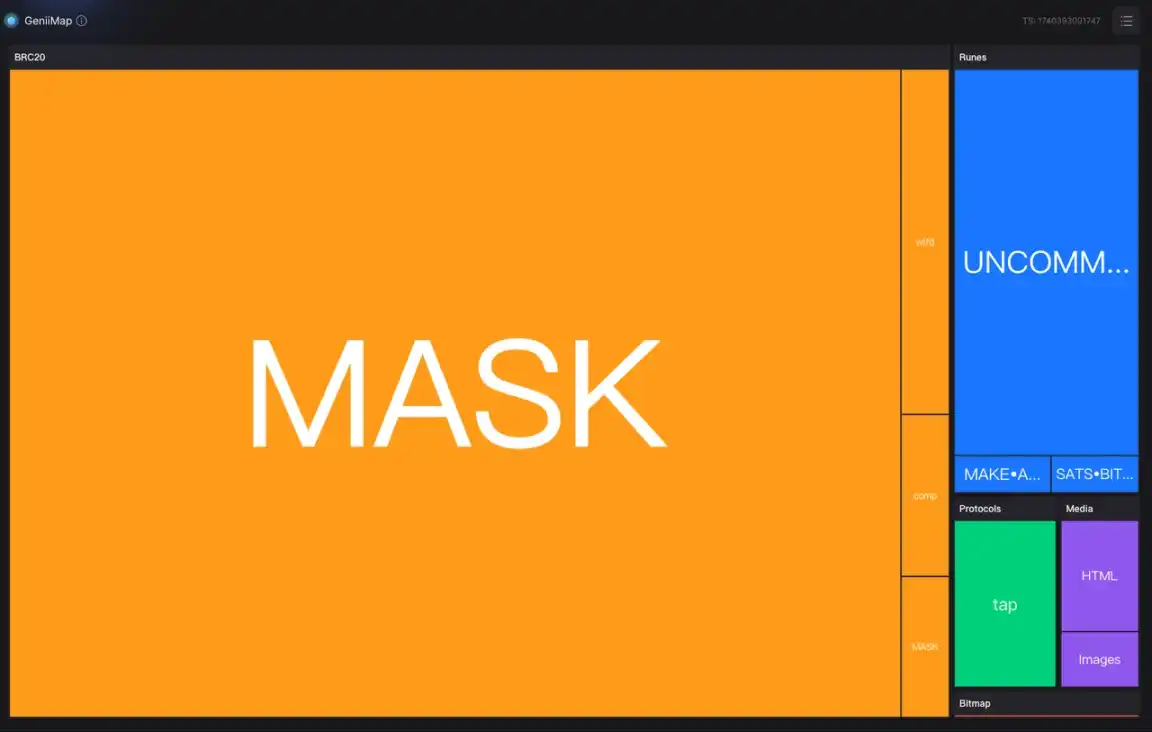
The total minting volume of MASK is 2.1 million tokens, with each token containing 10 coins. The current market price is around $0.18, with a total market value of approximately $3.06 million. As of the latest data, the minting progress of this project has reached 82.69%, and this increased activity has sparked widespread discussions in the market about the possibility of a new round of revival in the BRC-20 ecosystem.
From a deeper market logic perspective, the current crypto market is at a unique moment. As the conspiracy theories of the Solana and BSC ecosystems are widely questioned, the somewhat "fair" BRC-20 seems to have rekindled market attention. However, the market's memory has not faded with time, and the previous intense fluctuations in the Bitcoin ecosystem still cast a shadow over the market.
Watch Him Build a Tower High, Watch Him Watch It Fall
According to The Block data, starting from April 20, 2023, driven by the BRC-20 ecosystem, the number of transactions on the BTC network began to sharply rise, almost doubling in less than a month. The increase in transaction fees was even steeper, rising nearly tenfold in less than half a month. During the peak activity of the BRC-20 ecosystem, over 70% of on-chain transactions on the Bitcoin network were related to BRC-20 projects.
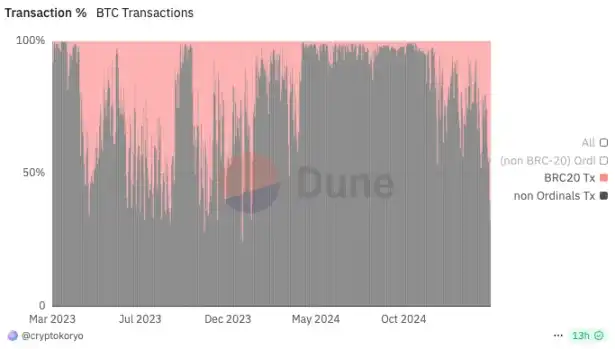
Behind this prosperous facade lies a fragile ecosystem foundation. After entering 2024, the Bitcoin ecosystem gradually fell into a downturn, a transformation that actually reflects the deep-seated challenges of the Bitcoin application layer. Although the market once had high hopes for the Bitcoin ecosystem, believing that innovation based on the script protocol could inject new vitality into the Bitcoin network, the actual development trajectory has deviated significantly from expectations.
Looking back at the development process of the BRC 20 ecosystem, we have to face a harsh reality. Most early popular projects experienced significant price retracements. ORDI dropped from a high of $87 to $11, Sats fell from 0.00000086 to 0.00000012, and other projects, including NFTs in the Bitcoin ecosystem, saw price drops of up to 90%, with many having already "returned to zero," leaving only a few projects with a strong grassroots culture.
This phenomenon is not accidental but rather the outward manifestation of deep-seated market structural issues. The BRC 20 protocol, from its design inception, embraced "true fairness" as a core principle. Through a fully transparent on-chain mechanism that eliminated reserves and scientist mechanisms, it aimed to provide all market participants with a truly equal opportunity to participate. While this design theoretically achieved the highest level of decentralization, it revealed significant limitations in practice.
The Paradox of Fairness and Market Control
From a market structure perspective, the scientist mechanism and initial chip distribution system in traditional crypto projects are essentially market regulation tools. Although these mechanisms are often criticized as manifestations of centralization, they play an indispensable role in maintaining market stability. Through these mechanisms, project teams can control market fluctuations to a certain extent, providing necessary price support for the project's long-term development.
However, the fully open minting mechanism in the BRC 20 ecosystem, while maximizing participation fairness, also resulted in highly dispersed chip structures. In the absence of effective price support mechanisms, market volatility tends to be more pronounced. In such scenarios, shifts in market sentiment can easily trigger chain reactions, leading to rapid price declines.
A deeper issue lies in the motivation of large funds to participate. In traditional crypto projects, large funds can influence market trends through various mechanisms to generate profits. However, under the inscription mechanism of BRC 20, this operational space is greatly reduced. When these so-called "whales" or "institutions" find it challenging to establish effective chip control, they naturally turn to other markets that offer easier fund management opportunities. This creates a paradox: the pursuit of absolute fairness may paradoxically lead to market instability, ultimately harming the interests of all participants. In such cases, the market needs to find a balance between complete fairness and necessary market stability.
The resurgence of the MASK project to some extent demonstrates that the market's yearning for a fair mechanism has not completely faded, regardless of whether this project still remains a "meteor." However, establishing an effective market stability mechanism while maintaining basic fairness remains a core challenge facing the entire crypto ecosystem. This requires innovation at the protocol design level and may involve introducing new mechanisms to balance decentralization and market stability, two seemingly contradictory goals.
You may also like

Morning Report | Coinbase Ventures makes its first investment in ENA; SpaceX plans to set the IPO price at $135 per share

Full text and analysis of the speech by the CEO of SanDisk at the 42nd Annual Strategic Decision Conference of Bernstein

Bitcoin Price Prediction 2030: Ark Invest Forecasts $710K

WEEX Review 2026: Fees, Security and Trading Features

SOL Price Today: Live Solana Price, Charts & Market Data

What Is a Bitcoin ETF: Spot vs Futures Explained

Why Is Bitcoin Dropping 15% While Nasdaq Hits Record Highs?

Morning Report | Robinhood completes acquisition of WonderFi for $180 million; Anthropic submits IPO draft application to SEC confidentially; Google plans to raise $80 billion in financing

WSJ: Hyperliquid is becoming Wall Street's crypto "convenience store"

Why do I still have confidence in ETH?

CRCL surges and plummets, COIN follows with a dive: The real battle for interests behind the CLARITY Act

Tokenized US stocks are not the "liquidity killer" of the crypto market

What Is TradFi and Why Is Everyone Talking About It in 2026?

From Poland to Paris: A Look Back at WEEX's Global Community Journey in May 2026

WEEX WXT Eco Carnival: How to Join WXT Events and Plan Trading Tasks
The WEEX WXT Eco Carnival is an ecosystem campaign built around WEEX Token (WXT), designed for users interested in platform tokens, spot trading, futures trading, deposit tasks, and referral rewards.

Morning Report | Strategy sold 32 BTC and over 800,000 shares of MSTR last week; Binance officially announced its U.S. stock trading portal; Polymarket reached an exclusive partnership with OneFootball
Zhou Hang: How much is SpaceX really worth?

IOSG: From Coinbase to Upbit: How a Token Completes a 28-Day Journey of Taking Over
Morning Report | Coinbase Ventures makes its first investment in ENA; SpaceX plans to set the IPO price at $135 per share
Full text and analysis of the speech by the CEO of SanDisk at the 42nd Annual Strategic Decision Conference of Bernstein
Bitcoin Price Prediction 2030: Ark Invest Forecasts $710K
WEEX Review 2026: Fees, Security and Trading Features
SOL Price Today: Live Solana Price, Charts & Market Data
What Is a Bitcoin ETF: Spot vs Futures Explained


