
Coinbase Report: Younger Generation No Longer Buying Homes or Stocks, Cryptocurrency Becomes Primary Wealth Battlefield

Original Title: State of Crypto Q4 2025: Younger investors are rewriting the investing playbook
Original Source: Coinbase
Original Translation: Chopper, Foresight News
For decades, the wealth accumulation path for Americans has remained almost unchanged: find a good job, buy real estate, invest in stocks, and then patiently wait for the power of compounding over time. However, our latest "Cryptocurrency Industry Report" shows that the younger generation of investors no longer believes in this traditional path and is adjusting their investment behavior.
To understand the market strategies of different generational groups and the role of cryptocurrency in their portfolios, Coinbase conducted a special study in partnership with Ipsos, interviewing a total of 4,350 US adults, including 2,005 investors with investment accounts. The core findings of the study are as follows: Generation Z and millennial investors, among other young investors, are more inclined than any previous generation to actively manage their investments, more willing to embrace non-traditional assets, and are more likely to view cryptocurrency as a core part of their financial future.
A Generation Excluded from the Traditional Wealth Ladder
Youthful investors are far more optimistic about the economy than older generations, but they believe that the existing financial system is not designed for them. Research data shows that nearly seventy percent (73%) of young people believe that their generation faces greater difficulty in accumulating wealth through traditional means compared to their parents' generation, while only 57% of the older generation share the same view.
They have witnessed housing costs skyrocket, student debt pile up, and wage growth stagnate. In this context, an increasing number of young people are seeking alternative wealth accumulation methods beyond the traditional model of "home equity + stock portfolio."
Non-Traditional Asset Allocation Ratio Triples that of Older Generations
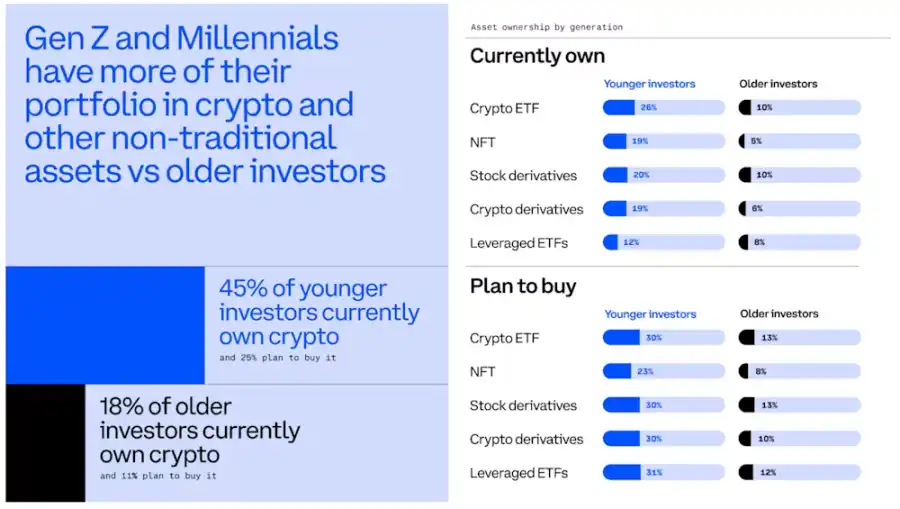
This anxiety is directly reflected in their asset allocation strategy. The research shows that young investors allocate 25% of their portfolio to non-traditional asset categories such as cryptocurrency, financial derivatives, non-fungible tokens (NFTs), and other emerging products. This ratio is three times that of older investors, whose allocation to non-traditional assets is only 8%.
The stock holding ratios of different generational cohorts are roughly similar, with the core difference being that young investors have diversified their portfolios beyond stocks. They are more actively seeking income opportunities beyond traditional stock dividends and, in order to narrow the wealth gap, are more willing to explore various new investment tools and emerging markets.
Cryptocurrency is by no means a side investment, but a core allocation
This shift in generational investment philosophy is most evident in the level of acceptance of cryptocurrency. The report shows that 45% of young investors already hold cryptocurrency, compared to only 18% among older investors. Furthermore, nearly half (47%) of young investors hope to be the first to access new types of crypto assets before the mainstream market; in contrast, only 16% of older investors have this aspiration.
In the eyes of the younger generation, cryptocurrency is not simply for speculative trading but is seen as an important avenue to help them catch up in wealth accumulation. Eight out of ten young people believe that cryptocurrency provides their generation with more financial opportunities outside the traditional financial system; at the same time, another eight out of ten young people firmly believe that the role of cryptocurrency in the future financial system will be greatly enhanced. In comparison, the proportion of older investors who agree with this view is only about sixty percent.
The younger generation's enthusiasm for exploring emerging markets is not limited to spot cryptocurrencies; they also aspire to engage with more non-traditional assets. Data shows that eight out of ten young investors are willing to be early adopters of new investment opportunities, a percentage that is still less than half among the older generation holding the same attitude. Young investors are always keenly interested in emerging non-traditional products such as cryptocurrency derivatives, prediction markets, 24/7 stock trading, early token sales, altcoins, decentralized finance lending, and more.
The impact of this trend on future markets
The young investor cohort has shown distinct traits: they trade more frequently, are willing to take on greater risks for higher returns, and are shifting a considerable portion of their portfolios towards non-traditional assets with cryptocurrency at the core. At the same time, they are driving the entire financial industry towards a transformation that better aligns with the needs of the internet-native generation, creating platforms that operate around the clock and support multi-asset trading.
You may also like

WEEX Deposit/Withdrawal Dynamic Island: Your Asset Status, Always in Sight

Scaling Crypto Derivatives: The Digital Asset Infrastructure Behind High-Volume Trading
In the fast-moving digital asset ecosystem, derivatives platforms face an extreme architectural test. High-leverage futures markets demand more than just standard security—they require absolute operational precision, zero-latency matching engines, and ironclad structural scalability, all while navigating intense market volatility.
As global platforms scale to meet these demands, the industry is shifting away from rigid, monolithic setups toward a more agile, "decoupled" infrastructure philosophy.
The Blueprint for High-Volume Copy TradingFor elite global exchanges like WEEX (founded in 2018), this architectural choice becomes critical when scaling high-volume retail features like social copy trading. When thousands of users automatically mirror the real-time strategies of elite traders simultaneously, it triggers sudden, monumental spikes in concurrent transactional volume.
To prevent execution latency or settlement bottlenecks during these peak volatility events, a platform's primary engine must remain entirely dedicated to risk management, copy-trade synchronization, and order matching.
The Architectural Rule: New-generation platforms must separate front-end user execution engines from heavy backend infrastructural overhead to eliminate operational friction.
By separating these layers, platforms can maintain complete sovereignty over their trading environments and user experiences while strategically aligning with institutional-grade infrastructure ecosystems. This strategic framework allows modern exchanges to leverage advanced Digital Asset Custody infrastructure such as Cobo’s behind the scenes, ensuring that backend wallet management scales elastically alongside trading spikes.
Capitalizing on Market Momentum and 400× LeverageIn a derivatives arena where platforms offer up to 400× leverage on perpetual contracts, capital efficiency and market agility are core business metrics. To capture market momentum, an exchange needs the ability to rapidly expand its asset offerings, supporting everything from legacy crypto assets to sudden, trending altcoins across a massive library of trading pairs.
Adopting a flexible, scalable Wallet-as-a-Service (WaaS) solution such as Cobo’s could completely rewrite the development timeline for high-growth exchanges. Instead of spending months of engineering capital building out custom backend wallet architectures for every new blockchain network, platforms can deploy localized infrastructure in days.
This agility allows platforms to instantly scale their listings to over a thousand trading pairs without compromising security or delaying time-to-market. It mirrors the exact operational advantages seen during high-velocity market events, similar to how advanced wallet infrastructure empowers platforms during sudden asset surges; allowing exchanges to pass that speed and liquidity directly to their global user base.
A Mature Foundation for GrowthThe synergy between trusted infrastructure ecosystems and global trading platforms represents the natural evolution of a maturing crypto market. As WEEX continues to scale its global spot and derivatives offerings for over 6 million users, adopting robust backend paradigms proves that platforms no longer have to compromise between cutting-edge trading velocity and uncompromised structural security.

Morning Report | BitMine increased its holdings by 126,971 ETH last week; trader Eugene announced his exit from the crypto market

Wang Chuan: How can one not feel anxious after the neighbor Old Wang made thirty times profit by investing in storage stocks? (Seven) - A quarter-century cycle

Get Paid to Onboard? Try WEEX’s New Homepage with Rewards for Registration, Deposit & Trade

WEEX Custom Layout: Build Your Perfect Trading Workspace in Seconds

See “Buy Walls” & “Sell Walls” Instantly: WEEX Launches the Depth Chart for Smarter Trades

What Is Quick Trade on WEEX? 2 Ways WEEX Ends Chart-Panel Jumping
Morning News | Five major virtual asset platforms in South Korea have experienced 57 incidents of hacking and system failures in six years; Grayscale submits registration application for Canton ETF

Should we escape the peak? The principle of the tail-end market in the stock market

RootData: May 2026 Cryptocurrency Exchange Transparency Research Report

Founder of Baixing.com: My Experience with Claude Code in Fourteen Points

Yang Ge Gary: Agent Economics and AI Microeconomics
When reasoning becomes a scarce resource, who captures its value?

Jensen Huang dramatically "rescues" the South Korean stock market

Stablecoins vs Deposit Tokens: On the surface, they seem like opposing sides, but in reality, they are interconnected

Bitcoin Crash to $50,000 or Bear Trap Before $100,000? Deep Dive for WEEX Traders
How Could the SpaceX IPO Affect Bitcoin, Altcoins season, and Crypto Liquidity?
WEEX Deposit/Withdrawal Dynamic Island: Your Asset Status, Always in Sight
Scaling Crypto Derivatives: The Digital Asset Infrastructure Behind High-Volume Trading
In the fast-moving digital asset ecosystem, derivatives platforms face an extreme architectural test. High-leverage futures markets demand more than just standard security—they require absolute operational precision, zero-latency matching engines, and ironclad structural scalability, all while navigating intense market volatility.
As global platforms scale to meet these demands, the industry is shifting away from rigid, monolithic setups toward a more agile, "decoupled" infrastructure philosophy.
The Blueprint for High-Volume Copy TradingFor elite global exchanges like WEEX (founded in 2018), this architectural choice becomes critical when scaling high-volume retail features like social copy trading. When thousands of users automatically mirror the real-time strategies of elite traders simultaneously, it triggers sudden, monumental spikes in concurrent transactional volume.
To prevent execution latency or settlement bottlenecks during these peak volatility events, a platform's primary engine must remain entirely dedicated to risk management, copy-trade synchronization, and order matching.
The Architectural Rule: New-generation platforms must separate front-end user execution engines from heavy backend infrastructural overhead to eliminate operational friction.
By separating these layers, platforms can maintain complete sovereignty over their trading environments and user experiences while strategically aligning with institutional-grade infrastructure ecosystems. This strategic framework allows modern exchanges to leverage advanced Digital Asset Custody infrastructure such as Cobo’s behind the scenes, ensuring that backend wallet management scales elastically alongside trading spikes.
Capitalizing on Market Momentum and 400× LeverageIn a derivatives arena where platforms offer up to 400× leverage on perpetual contracts, capital efficiency and market agility are core business metrics. To capture market momentum, an exchange needs the ability to rapidly expand its asset offerings, supporting everything from legacy crypto assets to sudden, trending altcoins across a massive library of trading pairs.
Adopting a flexible, scalable Wallet-as-a-Service (WaaS) solution such as Cobo’s could completely rewrite the development timeline for high-growth exchanges. Instead of spending months of engineering capital building out custom backend wallet architectures for every new blockchain network, platforms can deploy localized infrastructure in days.
This agility allows platforms to instantly scale their listings to over a thousand trading pairs without compromising security or delaying time-to-market. It mirrors the exact operational advantages seen during high-velocity market events, similar to how advanced wallet infrastructure empowers platforms during sudden asset surges; allowing exchanges to pass that speed and liquidity directly to their global user base.
A Mature Foundation for GrowthThe synergy between trusted infrastructure ecosystems and global trading platforms represents the natural evolution of a maturing crypto market. As WEEX continues to scale its global spot and derivatives offerings for over 6 million users, adopting robust backend paradigms proves that platforms no longer have to compromise between cutting-edge trading velocity and uncompromised structural security.
Morning Report | BitMine increased its holdings by 126,971 ETH last week; trader Eugene announced his exit from the crypto market
Wang Chuan: How can one not feel anxious after the neighbor Old Wang made thirty times profit by investing in storage stocks? (Seven) - A quarter-century cycle
Get Paid to Onboard? Try WEEX’s New Homepage with Rewards for Registration, Deposit & Trade
WEEX Custom Layout: Build Your Perfect Trading Workspace in Seconds


