
Etherscan's Surcharge Scandal Exposes Ethereum Ecosystem's Data Dependency Dilemma




Original Article Title: "Etherscan Cancels Several Free APIs, Revealing Unforeseen Issues"
Original Article Author: Eric, Foresight News
On November 23, Lefteris Karapetsas, the founder of the open-source portfolio tracker Rotki, took to Twitter to complain about Etherscan. He mentioned that during Devcon, Etherscan suddenly announced that they would no longer provide free APIs for the Avalanche C-Chain, Base, BNB Chain, and OP Mainnet block explorers.
While he understood the pressure of providing free services, he questioned why there was no advance notice or why such a decision was made during a major event when everyone was away, leading to a "sudden attack" without any time to react.
According to Etherscan's announcement, as the chain's performance gradually improved, the data volume also increased significantly, leading to a substantial rise in costs. In this situation, they could no longer afford to provide all APIs for free and had to reluctantly convert some previously free APIs into paid versions.
It is evident that the decision to no longer offer free APIs for specific chains was likely due to insufficient funding or resource support.
Finally, the founder expressed some confusion, questioning why, apart from Avalanche, Base, OP Mainnet, and BNB Chain did not have enough money to support such critical services.
However, opposing voices quickly emerged, with the founder of Routescan and operator of the Avalanche block explorer Snowtrace, Jack, at the forefront. Jack provided some industry-insider data:
· Etherscan charges supported chains approximately between $1.5 million to $2 million annually, with some as low as around $300,000, but providing only basic data;
· For chains that are already paying, Etherscan only provides a free API with 5 RPS (Requests Per Second), and for additional requests, the monthly subscription fee can go up to $899.
· Last month, the independent visitor numbers of various chain explorers on Etherscan were as follows: OP Mainnet, 102k; BNB Chain, 2.5M; Base, 1M; HyperEVM, 30k; Avalanche, 16k. Etherscan itself had 4M visitors.
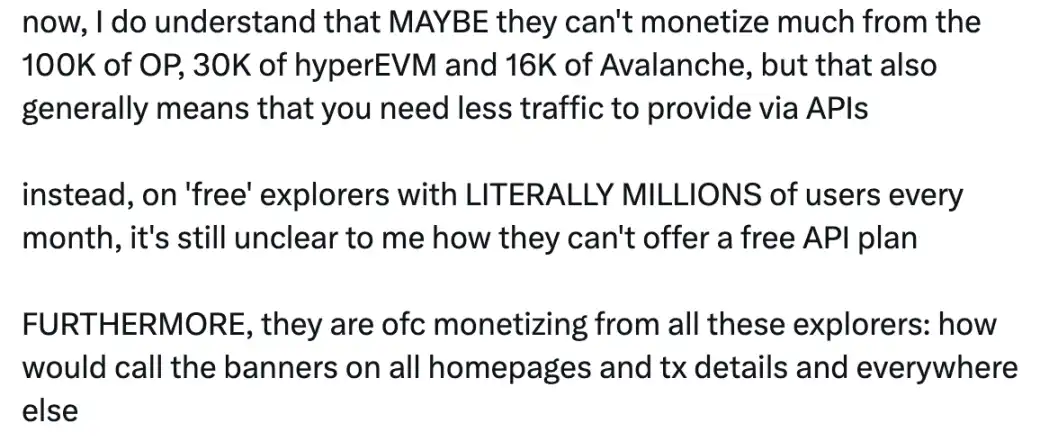
The CEO's implicit meaning is: Charging for a small number of APIs is indeed due to financial constraints, not because we find the income insignificant. For some chains that don't pay us, we have offered free service for a while and have done our utmost. Let's stop arguing about this and move on.
There isn't much to say about the discussion on this issue; it's simply a matter of some people thinking Etherscan is too greedy, while others view it as justifiable business behavior. However, some discussions arising from this event are quite interesting.
First of all, it was through this incident that the author learned about an ecosystem alliance called VERA, which promotes convenient, standardized, and open access to EVM smart contract source code, as well as the Open Labels Initiative, which drives the standardization framework and data model for EVM address labels. The fundamental goal of both organizations is to support the accessibility of blockchain data, especially validation.
The Open Labels Initiative retweeted Lefteris Karapetsas's complaint tweet, stating that over the past year, they have been working to prevent incidents like this caused by overreliance on centralized on-chain data providers. They believe that such critical infrastructure should not be monopolized but rather co-developed.
Entities such as sourcefify.eth for verifying Ethereum contract code, the Ethereum data visualization platform growthepie, the open-source block explorer Blockscout, and the previously mentioned Routescan are all contributing to the readability and accessibility of Ethereum data.
According to Akshat Mittal, a DeFi engineer at Reserve Protocol, Etherscan has not been involved in these initiatives. Is it for commercial gain? No one knows, but even if it is, it's understandable. The Ethereum ecosystem will always have individuals who adhere to open-source culture and reject excessive commercialization, which is not a matter of right or wrong but rather showcases the diversity of the ecosystem. Profit-driven institutions can ensure service quality, while open-source products will still have their place.
Furthermore, there has been recent effusive praise by IC's zCloak Network founder 0xFrancis, once again comparing IC to Ethereum.
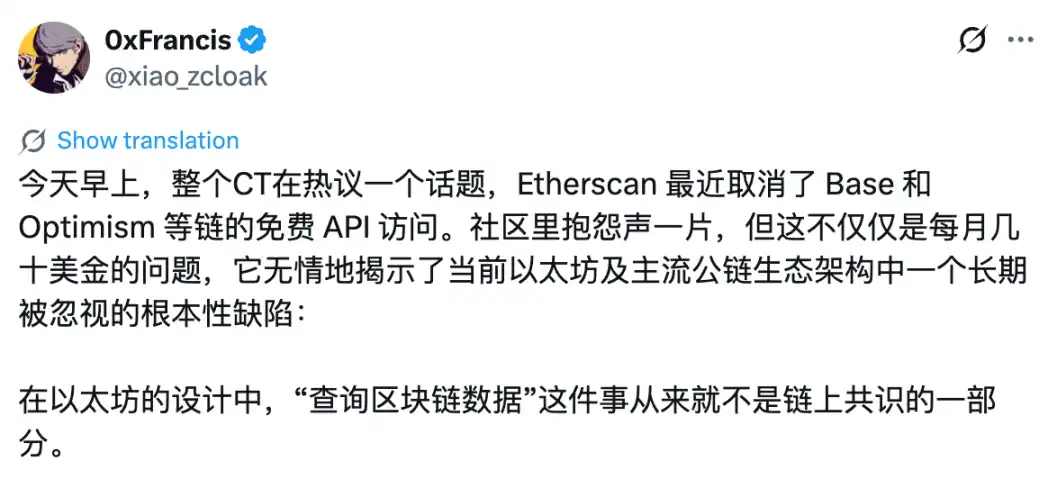
0xFrancis argues that Ethereum does not include "querying block data" as part of its consensus, so DApp development must rely on third-party RPC services. If RPC nodes collectively go offline, the chain will still run but become "unreadable."
Going deeper, if centralized RPC nodes or websites like Etherscan provide false data, they can easily deceive users. The Internet Computer (IC) incorporates querying as part of its protocol. When someone initiates a query, the request is executed through the ICP node network and returns cryptographically authenticated data to ensure its accuracy.
0xFrancis's point is not unfounded. This can be seen as a case of IC being too forward-thinking, with the Etherscan fee controversy being a typical debate about centralization versus decentralization. However, could it be that Ethereum's imperfections and the need for commercialized components have actually contributed to the ecosystem's prosperity?
You may also like

Morning Report | OpenAI has submitted an S-1 registration statement draft to the U.S. SEC; Morpho completes $175 million financing

Morning Report | BitMine increased its holdings by 126,971 ETH last week; trader Eugene announced his exit from the crypto market

Wang Chuan: How can one not feel anxious after the neighbor Old Wang made thirty times profit by investing in storage stocks? (Seven) - A quarter-century cycle

Cryptocurrency CEXs are flocking to sell US stocks, and traditional brokerages are facing an "uninvited guest."

$75 billion in foreign capital has fled, and South Korean retail investors have absorbed it all using leverage

Japan’s Three Megabanks Plan Joint Stablecoin Issuance in Fiscal 2026
MUFG, SMBC, and Mizuho reportedly plan to jointly issue fiat-pegged stablecoins in fiscal 2026, signaling Japan’s growing push into bank-led digital payment infrastructure.

Humanity Discloses H Token Dual-Chain Attack Details, With Losses on Ethereum and BSC Exceeding $36 Million
Humanity said the H token attack across Ethereum and BSC caused more than $36 million in losses after leaked ProxyAdmin keys enabled malicious contract upgrades and token minting.
White House Discusses CLARITY Act With Law Enforcement Ahead of Senate Vote
The White House discussed the CLARITY Act with law enforcement ahead of a Senate vote, focusing on illicit finance risks and developer protections.

Bitcoin Trading Guide 2026: Strategies for Experienced Traders

What Is XAUT and PAXG? Why Tokenized Gold Is Booming in 2026

Will the SpaceX IPO Hurt Bitcoin? Here's What Traders Are Watching

Foreign selling in the South Korean stock market accelerates, with cumulative net sales reportedly reaching $75 billion this year
On June 9, The Kobeissi Letter, citing Goldman Sachs data, reported that global investors are selling South Korean stocks at an unusually rapid pace. In the latest trading session, foreign investors sold about $801 million worth of Kospi constituent stocks again; total foreign outflows last week reached about $10 billion, and the market has been in net foreign selling on nearly every trading day over the past month. According to the data cited in the report, foreign investors have sold about $75 billion worth of South Korean stocks so far this year. Meanwhile, South Korean retail and institutional investors together recorded roughly $69 billion in net buying over the same period, suggesting that the market’s main buying support has come from domestic capital rather than returning overseas funds. The information currently disclosed still mainly comes from The Kobeissi Letter’s retelling and Goldman Sachs data summaries, while public details on the statistical period and the specific definition of “selling” remain relatively limited.

Fortune Warns of Strategy’s Financing Structure Risks as Bitcoin Premium Narrows
Fortune warned that Strategy’s Bitcoin treasury model faces growing financing risks as MSTR’s net asset premium narrows and preferred stock dividend pressure increases.

Ferrari Challenge Le Mans: Carl Moon to Dominate in WEEX Livery

Sahara AI Responds to SAHARA’s Sharp Drop: No Contract or Product Security Issues Found, Internal Investigation Underway
Sahara AI responded to SAHARA’s 60% price drop, saying no token contract or product security issues have been found and an internal investigation is underway.

WEEX Deposit/Withdrawal Dynamic Island: Your Asset Status, Always in Sight
Scaling Crypto Derivatives: The Digital Asset Infrastructure Behind High-Volume Trading
In the fast-moving digital asset ecosystem, derivatives platforms face an extreme architectural test. High-leverage futures markets demand more than just standard security—they require absolute operational precision, zero-latency matching engines, and ironclad structural scalability, all while navigating intense market volatility.
As global platforms scale to meet these demands, the industry is shifting away from rigid, monolithic setups toward a more agile, "decoupled" infrastructure philosophy.
The Blueprint for High-Volume Copy TradingFor elite global exchanges like WEEX (founded in 2018), this architectural choice becomes critical when scaling high-volume retail features like social copy trading. When thousands of users automatically mirror the real-time strategies of elite traders simultaneously, it triggers sudden, monumental spikes in concurrent transactional volume.
To prevent execution latency or settlement bottlenecks during these peak volatility events, a platform's primary engine must remain entirely dedicated to risk management, copy-trade synchronization, and order matching.
The Architectural Rule: New-generation platforms must separate front-end user execution engines from heavy backend infrastructural overhead to eliminate operational friction.
By separating these layers, platforms can maintain complete sovereignty over their trading environments and user experiences while strategically aligning with institutional-grade infrastructure ecosystems. This strategic framework allows modern exchanges to leverage advanced Digital Asset Custody infrastructure such as Cobo’s behind the scenes, ensuring that backend wallet management scales elastically alongside trading spikes.
Capitalizing on Market Momentum and 400× LeverageIn a derivatives arena where platforms offer up to 400× leverage on perpetual contracts, capital efficiency and market agility are core business metrics. To capture market momentum, an exchange needs the ability to rapidly expand its asset offerings, supporting everything from legacy crypto assets to sudden, trending altcoins across a massive library of trading pairs.
Adopting a flexible, scalable Wallet-as-a-Service (WaaS) solution such as Cobo’s could completely rewrite the development timeline for high-growth exchanges. Instead of spending months of engineering capital building out custom backend wallet architectures for every new blockchain network, platforms can deploy localized infrastructure in days.
This agility allows platforms to instantly scale their listings to over a thousand trading pairs without compromising security or delaying time-to-market. It mirrors the exact operational advantages seen during high-velocity market events, similar to how advanced wallet infrastructure empowers platforms during sudden asset surges; allowing exchanges to pass that speed and liquidity directly to their global user base.
A Mature Foundation for GrowthThe synergy between trusted infrastructure ecosystems and global trading platforms represents the natural evolution of a maturing crypto market. As WEEX continues to scale its global spot and derivatives offerings for over 6 million users, adopting robust backend paradigms proves that platforms no longer have to compromise between cutting-edge trading velocity and uncompromised structural security.

Get Paid to Onboard? Try WEEX’s New Homepage with Rewards for Registration, Deposit & Trade
Morning Report | OpenAI has submitted an S-1 registration statement draft to the U.S. SEC; Morpho completes $175 million financing
Morning Report | BitMine increased its holdings by 126,971 ETH last week; trader Eugene announced his exit from the crypto market
Wang Chuan: How can one not feel anxious after the neighbor Old Wang made thirty times profit by investing in storage stocks? (Seven) - A quarter-century cycle
Cryptocurrency CEXs are flocking to sell US stocks, and traditional brokerages are facing an "uninvited guest."
$75 billion in foreign capital has fled, and South Korean retail investors have absorbed it all using leverage
Japan’s Three Megabanks Plan Joint Stablecoin Issuance in Fiscal 2026
MUFG, SMBC, and Mizuho reportedly plan to jointly issue fiat-pegged stablecoins in fiscal 2026, signaling Japan’s growing push into bank-led digital payment infrastructure.


