
From Panic to Reversal, BTC Surges to $93K: Has the Structural Turning Point Arrived?

Original Article Title: "BTC Returns to $93,000: Four Major Macro Signals Resonate, Crypto Market May Welcome a Structural Turning Point"
Original Article Author: Dingdang, Odaily Star Daily
Over the past 48 hours, the crypto market once again reminded everyone in an almost dramatic way: here, "plunges" and "bull returns" are always just a day's trading apart. BTC staged a strong rebound to near $93,000, with a 24-hour gain of close to 7%; ETH returned above $3,000; SOL also retested $140.
After the U.S. stock market opened, the crypto sector also showed a general rise. BitMine, an ETH treasury company, saw its stock price rise by 11.6% in 24 hours, and Strategy, the largest BTC corporate holder, saw a 6.2% increase.
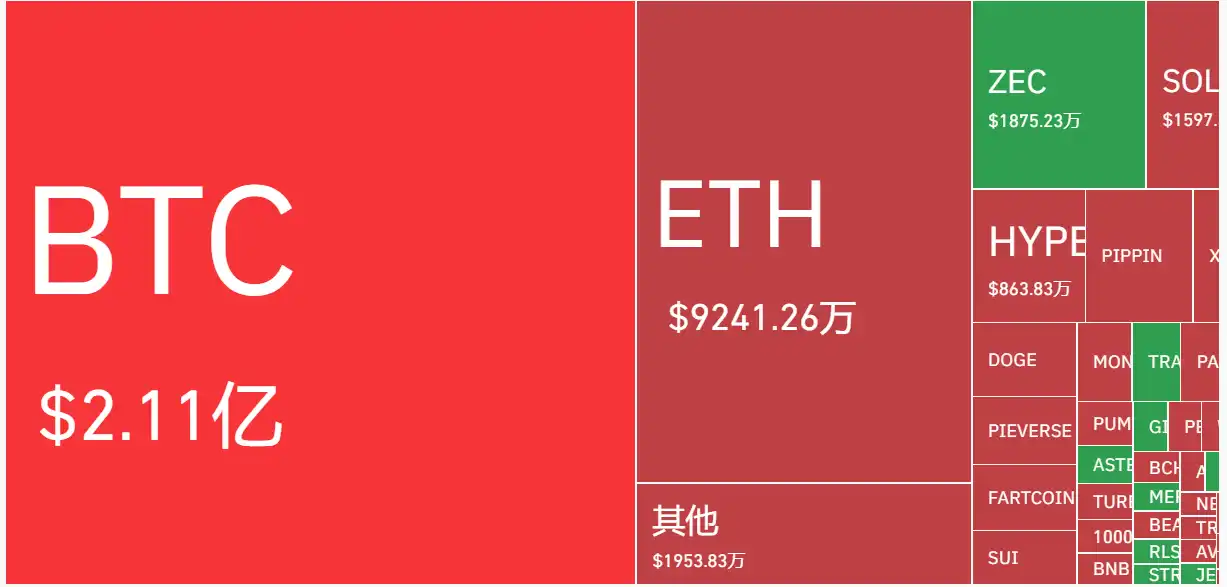
In terms of derivatives, the total liquidation amount in the past 24 hours reached $430 million, with long liquidations totaling $70 million and short liquidations totaling $360 million. The main liquidation was a short position, and the largest single liquidation occurred on Bybit - BTCUSD, with a position value of $13 million.
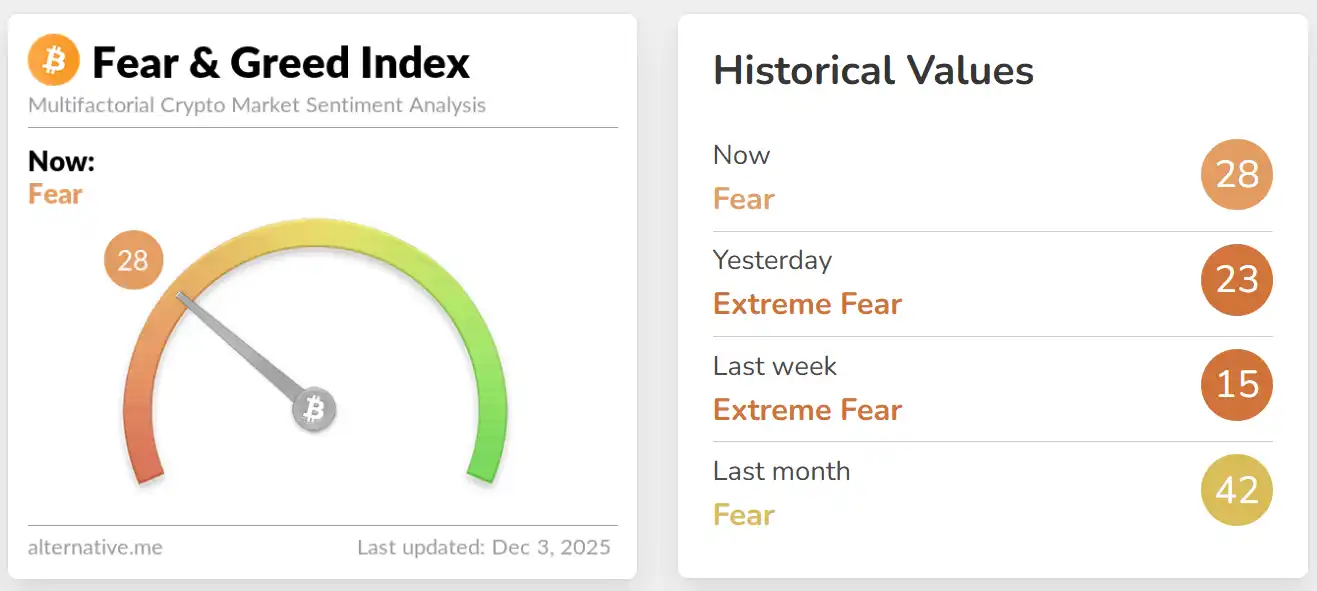
In terms of market sentiment, according to Alternative.me data, today's cryptocurrency fear and greed index has risen to 28, still in the "fear" zone, but compared to yesterday's 23 (extreme fear), sentiment has clearly improved, and the market is showing signs of a slight recovery.
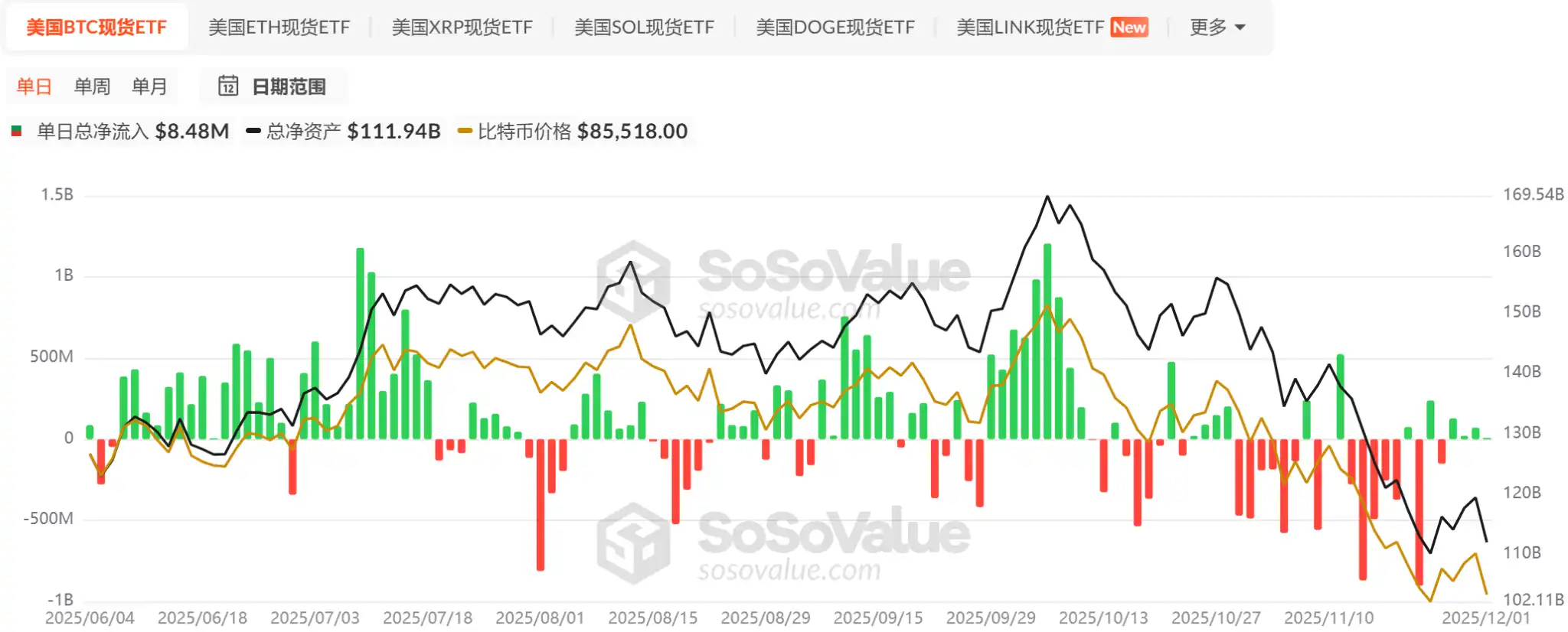
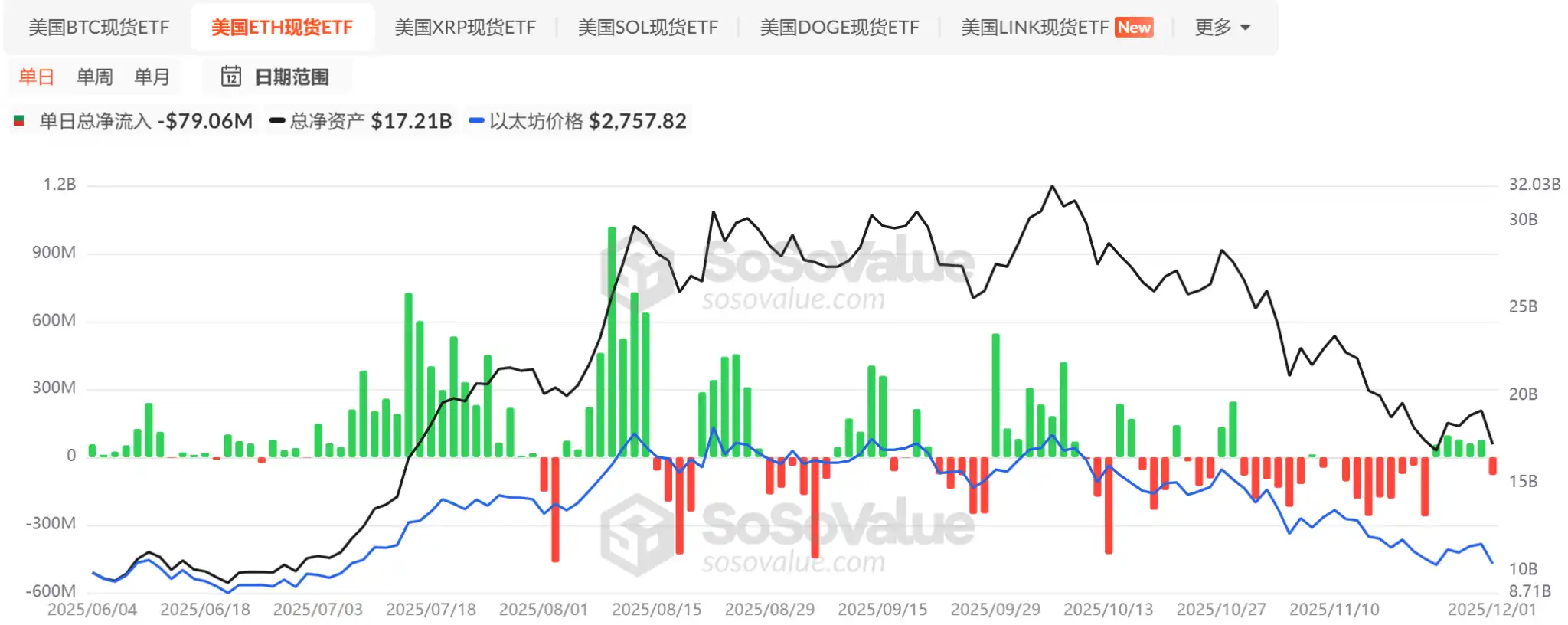
Regarding fund inflows, according to sosovalue.com data, after BTC spot ETFs experienced intense outflows for four consecutive weeks, they finally saw modest inflows for four consecutive trading days; ETH spot ETFs, on the other hand, turned into net outflows of $79 million after five consecutive inflows. Overall, the current momentum of fund inflows is still relatively weak.
Meanwhile, altcoin ETFs have accelerated their approvals under policy dividends, with XRP, SOL, LTC, DOGE, and other ETFs being listed intensively. Among them, although the XRP ETF was later than the SOL ETF, its performance was even more remarkable. Its current total net inflow has reached $824 million, surpassing the SOL ETF, and in the short term has become the "institutional representative work" of altcoins.
Superficially, the recent surge in the crypto market seems to lack a significant direct catalyst, but in reality, forces beneath the surface are synchronously building up──from rate expectations to liquidity inflection, and to the restructuring of institutional allocation logic, each is potent enough to steer the market direction.
Forecast Reversal: December Rate Cut Appears Set in Stone
Analysts at Goldman Sachs' Fixed Income, Currency, and Commodities (FICC) division believe that an interest rate cut by the Federal Reserve at the upcoming December meeting has essentially become a done deal. Similarly, Bank of America's Global Research division indicates that due to the soft labor market conditions and recent hints from policymakers suggesting an early rate cut, they now expect the Fed to cut rates by 25 basis points at the December meeting. This is a shift from the bank's previous expectation of the Fed maintaining rates at the December meeting. At the same time, the bank currently forecasts rate cuts of 25 basis points each in June and July 2026, bringing the final rate to a range of 3.00%-3.25%.
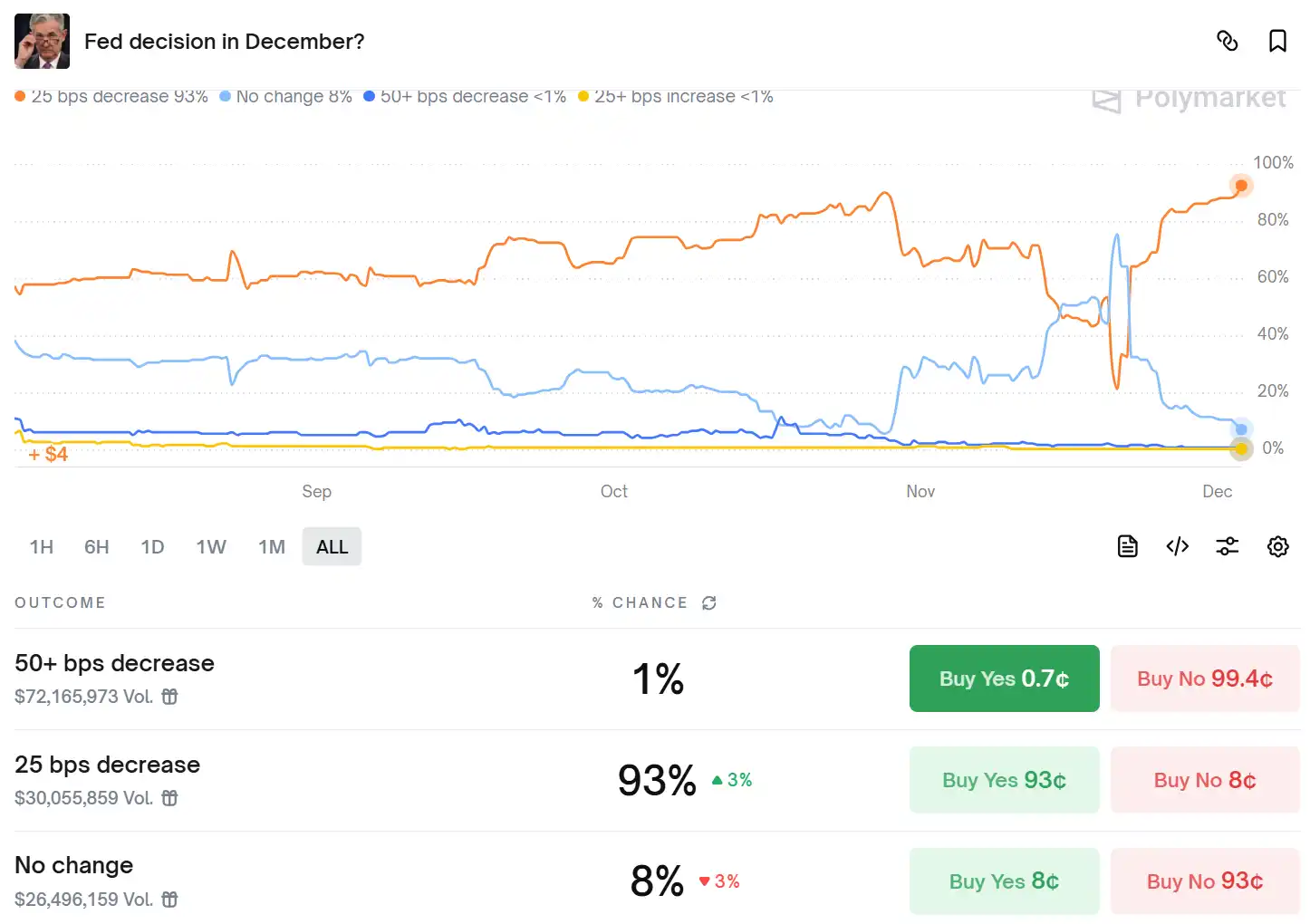
Polymarket data shows that the probability of the Fed cutting rates by 25 basis points next week has risen to 93%, with the total trading volume in this prediction pool reaching $300 million.
Liquidity Shift: QT Conclusion and $135 Billion Infusion
A more crucial signal comes from the Federal Reserve's balance sheet operations. Quantitative Tightening (QT) officially concluded on December 1, having previously withdrawn over $2.4 trillion in liquidity from the system, stabilizing the Fed's balance sheet around $6.57 trillion.
Of more significance, on the same day, the Fed injected $135 billion in liquidity into the market through overnight repo tools, marking the second-largest single-day liquidity injection since the pandemic, aimed at alleviating short-term funding pressures in banks. However, this is not quantitative easing (QE) but rather temporary liquidity support.
Powell's Successor: Political Variable Before Christmas
Beyond liquidity and rates, another thread affecting market sentiment comes from politics. With Powell's term set to end in May next year, the search for the next Federal Reserve Chair has fully commenced, with five candidates currently vying for arguably the most crucial position in the U.S. economy. These contenders include Federal Reserve Governors Christopher Waller, Michelle Bowman, former Fed Governor Kevin Warsh, BlackRock's Rick Rieder, and NEC Director Haslett. U.S. Treasury Secretary Bassett, who oversees the selection process, stated last week that Trump may announce his nominee before the Christmas holiday.
Insiders say Trump trusts Hassett and believes he shares his desire for a more aggressive rate cut by the central bank. Hassett has indicated he would accept the position if offered.
Asset Management Giants Easing Up: Crypto ETF Officially Enters "Mainstream Wealth Management"
Over the past few years, traditional giants like Vanguard and Merrill Lynch have always kept their distance from crypto ETFs—not because they don't understand, but because they are "risk-averse." However, this week, as Vanguard and Merrill announced expanded client access to crypto ETFs and Charles Schwab planned to open Bitcoin trading in the first half of 2026, this landscape has finally started to loosen up.
Importantly, the style of traditional institutions has always been "prefer to miss out than step on a landmine." Their loosening grip is not a short-term trading signal but a long-term strategic shift. If the above institutions allocate just 0.25% of their funds to BTC, it also means there will be approximately $750 billion of structural incremental buying pressure in the next 12-24 months. Coupled with relaxed monetary conditions, 2026 is poised for strong growth.
Furthermore, one of the largest financial institutions in the U.S., Bank of America, has allowed wealth advisors to recommend allocating 1%-4% to crypto assets to clients starting from January 2025, with the initial recommended assets being IBIT, FBTC, BITB, and BTC—meaning BTC has officially entered the "standard allocation" list of traditional U.S. wealth management. This move aligns Bank of America's wealth management platform with major institutions like BlackRock and Morgan Stanley. For Wells Fargo and Goldman Sachs, which have been slow to act, industry pressure is rapidly mounting.
Conclusion
The rebound in this market is not solely driven by a single positive development, but more like multiple macro clues resonating at the same time: clear rate cut expectations, liquidity inflow, approaching political variables, and asset management giants easing up. More importantly, crypto assets are transitioning from "allowed to trade" to "acknowledged allocation," propelling them towards a more sustainable fund-driven cycle.
You may also like

Japan’s Three Megabanks Plan Joint Stablecoin Issuance in Fiscal 2026
MUFG, SMBC, and Mizuho reportedly plan to jointly issue fiat-pegged stablecoins in fiscal 2026, signaling Japan’s growing push into bank-led digital payment infrastructure.

Humanity Discloses H Token Dual-Chain Attack Details, With Losses on Ethereum and BSC Exceeding $36 Million
Humanity said the H token attack across Ethereum and BSC caused more than $36 million in losses after leaked ProxyAdmin keys enabled malicious contract upgrades and token minting.

White House Discusses CLARITY Act With Law Enforcement Ahead of Senate Vote
The White House discussed the CLARITY Act with law enforcement ahead of a Senate vote, focusing on illicit finance risks and developer protections.

$75 billion in foreign capital has fled, and South Korean retail investors have absorbed it all using leverage

Bitcoin Trading Guide 2026: Strategies for Experienced Traders

What Is XAUT and PAXG? Why Tokenized Gold Is Booming in 2026

Cryptocurrency CEXs are flocking to sell US stocks, and traditional brokerages are facing an "uninvited guest."

Will the SpaceX IPO Hurt Bitcoin? Here's What Traders Are Watching
Foreign selling in the South Korean stock market accelerates, with cumulative net sales reportedly reaching $75 billion this year
On June 9, The Kobeissi Letter, citing Goldman Sachs data, reported that global investors are selling South Korean stocks at an unusually rapid pace. In the latest trading session, foreign investors sold about $801 million worth of Kospi constituent stocks again; total foreign outflows last week reached about $10 billion, and the market has been in net foreign selling on nearly every trading day over the past month. According to the data cited in the report, foreign investors have sold about $75 billion worth of South Korean stocks so far this year. Meanwhile, South Korean retail and institutional investors together recorded roughly $69 billion in net buying over the same period, suggesting that the market’s main buying support has come from domestic capital rather than returning overseas funds. The information currently disclosed still mainly comes from The Kobeissi Letter’s retelling and Goldman Sachs data summaries, while public details on the statistical period and the specific definition of “selling” remain relatively limited.

Fortune Warns of Strategy’s Financing Structure Risks as Bitcoin Premium Narrows
Fortune warned that Strategy’s Bitcoin treasury model faces growing financing risks as MSTR’s net asset premium narrows and preferred stock dividend pressure increases.

Ferrari Challenge Le Mans: Carl Moon to Dominate in WEEX Livery

Sahara AI Responds to SAHARA’s Sharp Drop: No Contract or Product Security Issues Found, Internal Investigation Underway
Sahara AI responded to SAHARA’s 60% price drop, saying no token contract or product security issues have been found and an internal investigation is underway.

WEEX Deposit/Withdrawal Dynamic Island: Your Asset Status, Always in Sight
Scaling Crypto Derivatives: The Digital Asset Infrastructure Behind High-Volume Trading
In the fast-moving digital asset ecosystem, derivatives platforms face an extreme architectural test. High-leverage futures markets demand more than just standard security—they require absolute operational precision, zero-latency matching engines, and ironclad structural scalability, all while navigating intense market volatility.
As global platforms scale to meet these demands, the industry is shifting away from rigid, monolithic setups toward a more agile, "decoupled" infrastructure philosophy.
The Blueprint for High-Volume Copy TradingFor elite global exchanges like WEEX (founded in 2018), this architectural choice becomes critical when scaling high-volume retail features like social copy trading. When thousands of users automatically mirror the real-time strategies of elite traders simultaneously, it triggers sudden, monumental spikes in concurrent transactional volume.
To prevent execution latency or settlement bottlenecks during these peak volatility events, a platform's primary engine must remain entirely dedicated to risk management, copy-trade synchronization, and order matching.
The Architectural Rule: New-generation platforms must separate front-end user execution engines from heavy backend infrastructural overhead to eliminate operational friction.
By separating these layers, platforms can maintain complete sovereignty over their trading environments and user experiences while strategically aligning with institutional-grade infrastructure ecosystems. This strategic framework allows modern exchanges to leverage advanced Digital Asset Custody infrastructure such as Cobo’s behind the scenes, ensuring that backend wallet management scales elastically alongside trading spikes.
Capitalizing on Market Momentum and 400× LeverageIn a derivatives arena where platforms offer up to 400× leverage on perpetual contracts, capital efficiency and market agility are core business metrics. To capture market momentum, an exchange needs the ability to rapidly expand its asset offerings, supporting everything from legacy crypto assets to sudden, trending altcoins across a massive library of trading pairs.
Adopting a flexible, scalable Wallet-as-a-Service (WaaS) solution such as Cobo’s could completely rewrite the development timeline for high-growth exchanges. Instead of spending months of engineering capital building out custom backend wallet architectures for every new blockchain network, platforms can deploy localized infrastructure in days.
This agility allows platforms to instantly scale their listings to over a thousand trading pairs without compromising security or delaying time-to-market. It mirrors the exact operational advantages seen during high-velocity market events, similar to how advanced wallet infrastructure empowers platforms during sudden asset surges; allowing exchanges to pass that speed and liquidity directly to their global user base.
A Mature Foundation for GrowthThe synergy between trusted infrastructure ecosystems and global trading platforms represents the natural evolution of a maturing crypto market. As WEEX continues to scale its global spot and derivatives offerings for over 6 million users, adopting robust backend paradigms proves that platforms no longer have to compromise between cutting-edge trading velocity and uncompromised structural security.

Morning Report | BitMine increased its holdings by 126,971 ETH last week; trader Eugene announced his exit from the crypto market

Wang Chuan: How can one not feel anxious after the neighbor Old Wang made thirty times profit by investing in storage stocks? (Seven) - A quarter-century cycle

Get Paid to Onboard? Try WEEX’s New Homepage with Rewards for Registration, Deposit & Trade
WEEX Custom Layout: Build Your Perfect Trading Workspace in Seconds
Japan’s Three Megabanks Plan Joint Stablecoin Issuance in Fiscal 2026
MUFG, SMBC, and Mizuho reportedly plan to jointly issue fiat-pegged stablecoins in fiscal 2026, signaling Japan’s growing push into bank-led digital payment infrastructure.
Humanity Discloses H Token Dual-Chain Attack Details, With Losses on Ethereum and BSC Exceeding $36 Million
Humanity said the H token attack across Ethereum and BSC caused more than $36 million in losses after leaked ProxyAdmin keys enabled malicious contract upgrades and token minting.
White House Discusses CLARITY Act With Law Enforcement Ahead of Senate Vote
The White House discussed the CLARITY Act with law enforcement ahead of a Senate vote, focusing on illicit finance risks and developer protections.
$75 billion in foreign capital has fled, and South Korean retail investors have absorbed it all using leverage
Bitcoin Trading Guide 2026: Strategies for Experienced Traders
What Is XAUT and PAXG? Why Tokenized Gold Is Booming in 2026


