
Grayscale Submits IPO Application: Cryptocurrency Giant with $35 Billion AUM Finally at the Doorstep of the Stock Market

Original Article Title: "Grayscale, Once Tough SEC, is about to Land on the NYSE"
Original Article Author: Eric, Foresight News
On the evening of November 13th, Beijing time, Grayscale submitted an IPO application to the NYSE, planning to debut on the US stock market through Grayscale Investment, Inc. This IPO is led by Morgan Stanley, BofA Securities, Jefferies, and Cantor.
It is worth noting that Grayscale's listing this time adopts an Umbrella Partnership structure (Up-C). In this structure, Grayscale's operational and controlling entity, Grayscale Operating, LLC, is not the listing entity. Instead, the IPO is conducted through a newly established listing entity, Grayscale Investment, Inc., which acquires a portion of LLC's equity to facilitate public trading. The company's founders and early investors can convert their LLC interests into shares of the listing entity, enjoying capital gains tax benefits in the process by only paying personal income tax. IPO investors, on the other hand, need to pay taxes on corporate profits and personal income tax on stock dividends.
Such a listing structure not only benefits the company's "elders" in terms of taxation but also allows for post-listing absolute control through dual-class shares. The S-1 filing shows that Grayscale is wholly owned by its parent company DCG, and Grayscale explicitly states that post-listing, the DCG parent company will retain decision-making control over Grayscale through 100% ownership of B class shares with greater voting rights. The funds raised through the IPO will also be used entirely to purchase equity from the LLC.
Everyone is no stranger to Grayscale, which first launched Bitcoin and Ethereum investment products and, through a tough battle with the SEC, achieved the conversion of Bitcoin and Ethereum trusts into spot ETFs. Its launch of the Digital Large Cap Fund also had the power of a "cryptocurrency version of the S&P 500." During the last bull market cycle, every adjustment to the large-cap fund caused significant short-term price fluctuations for the tokens being removed and added.
S-1 filings show that as of September 30th of this year, Grayscale's total AUM reached $35 billion, making it the world's largest cryptocurrency asset manager. It has over 40 different digital asset investment products covering more than 45 cryptocurrencies. The $35 billion includes $33.9 billion in AUM of ETPs and ETFs (primarily Bitcoin, Ethereum, SOL-related products) and $1.1 billion in private funds (primarily altcoin investment products).
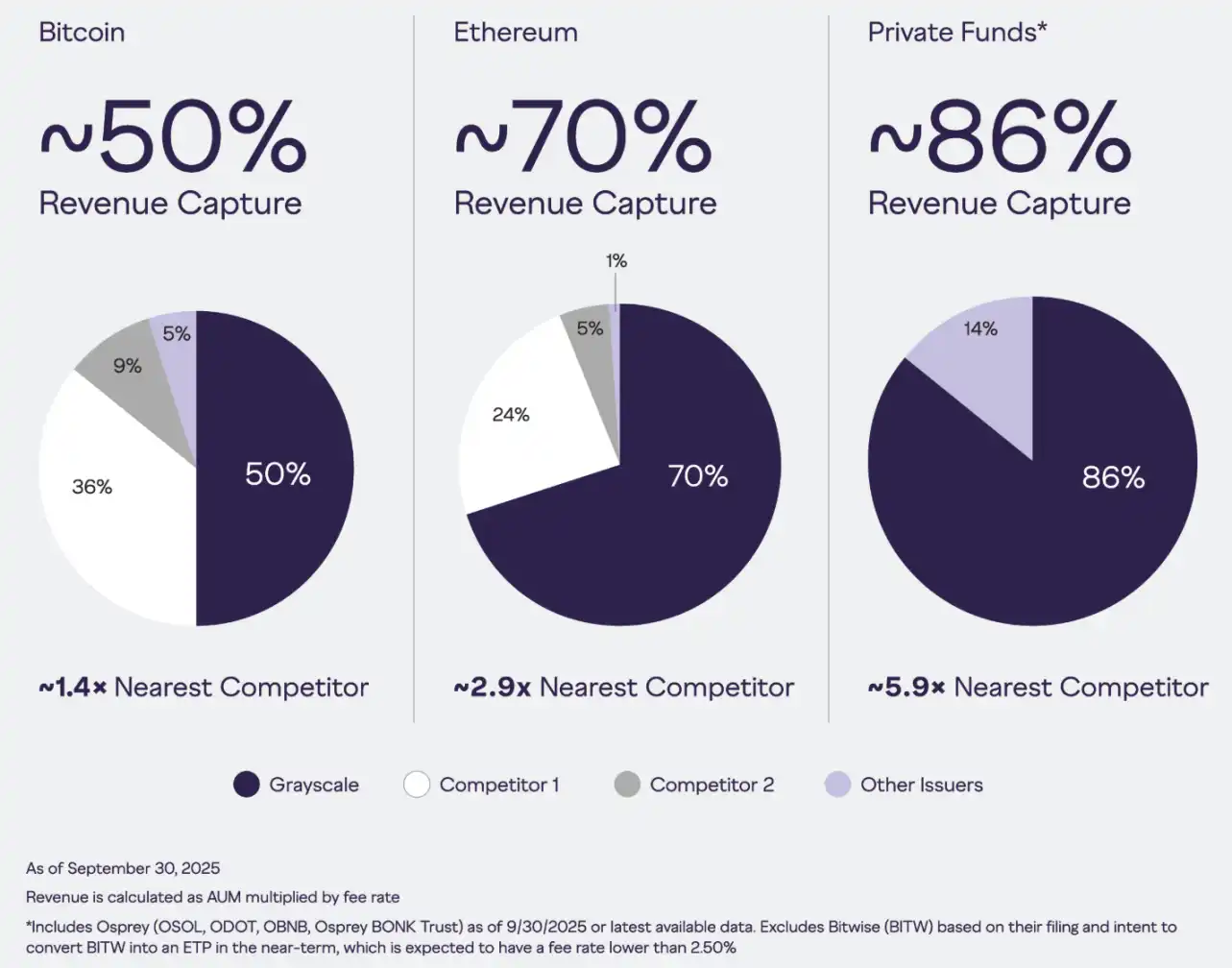
In addition, purely in terms of revenue, Grayscale's main investment products have a stronger revenue-generating capability compared to its primary competitors. However, this is mainly due to the previously non-redeemable trust accumulation of AUM and an above-peer-average management fee.
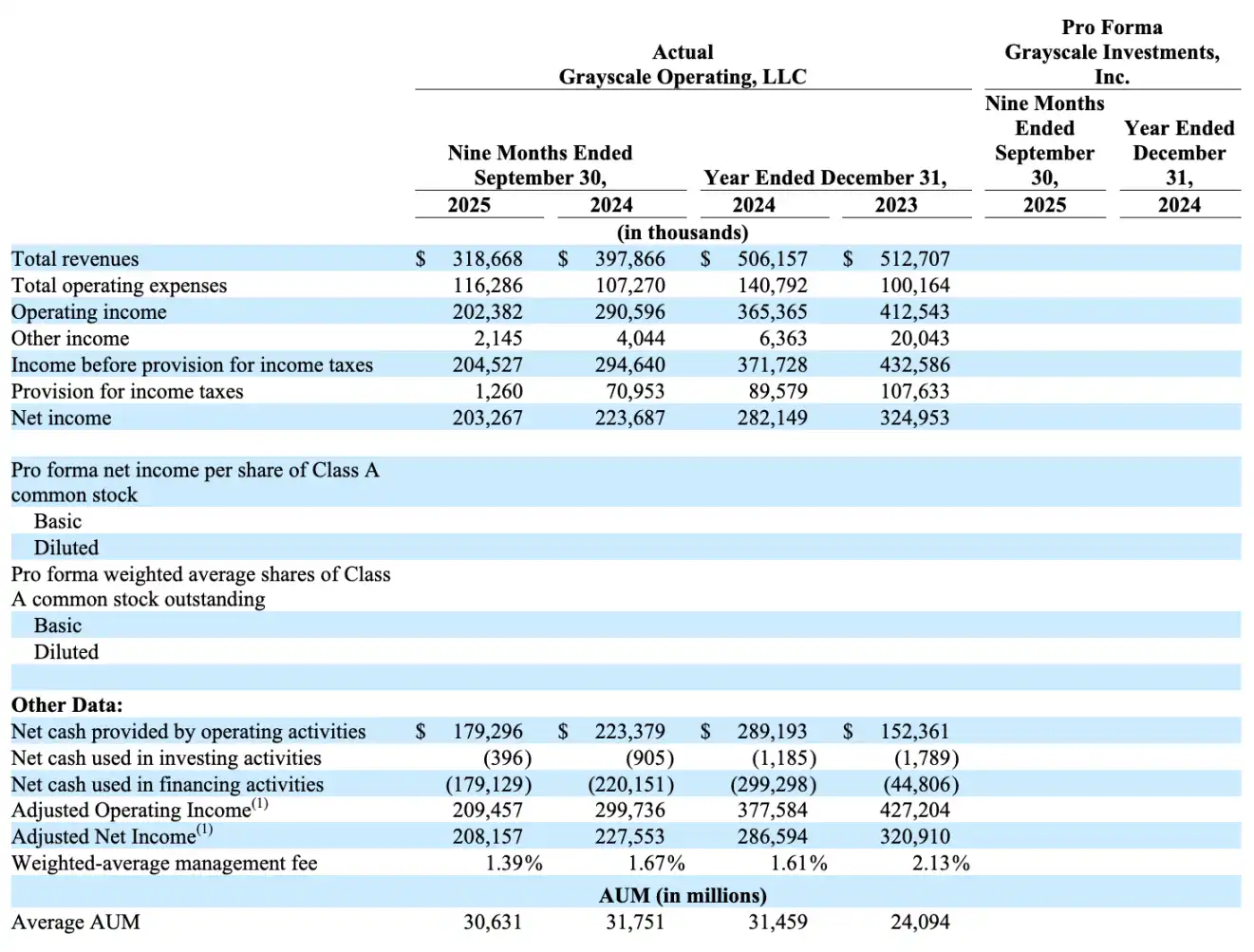
Financially, for the nine months ending September 30, 2025, Grayscale's operating revenue was approximately $3.19 billion, a 20% year-over-year decrease. Operating expenses were around $1.16 billion, an 8.4% year-over-year increase. Operating profit stood at about $2.02 billion, a 30.4% year-over-year decrease. Including other income and deducting the provision for income taxes, the net profit was approximately $2.03 billion, down 9.1% year-over-year. Additionally, average AUM data indicates a possible decrease in AUM compared to last year.
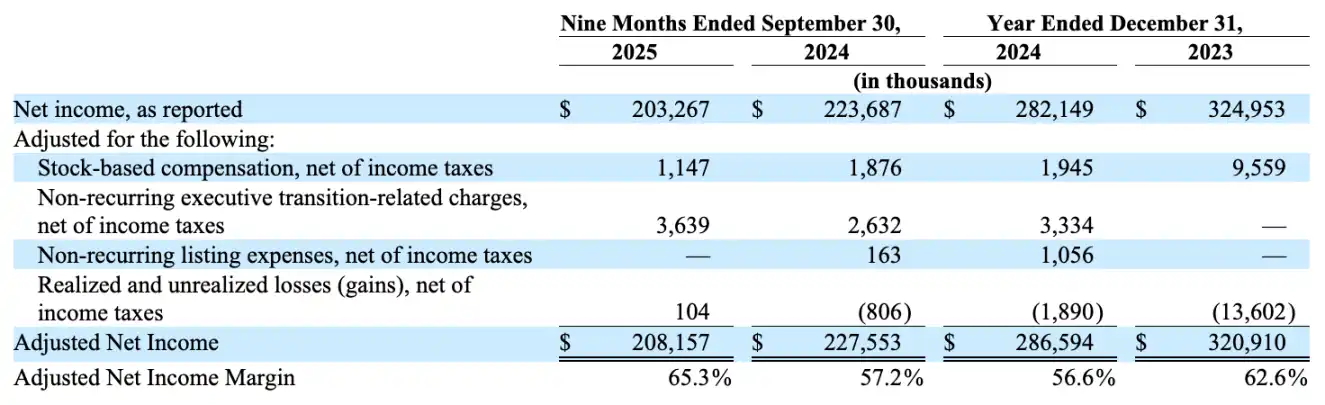
Excluding non-recurring items, the adjusted net profit for the reporting period was about $2.08 billion, with a net profit margin of 65.3%. Although the former decreased by 8.5% year-over-year, the net profit margin increased compared to the same period last year at 57.2%.
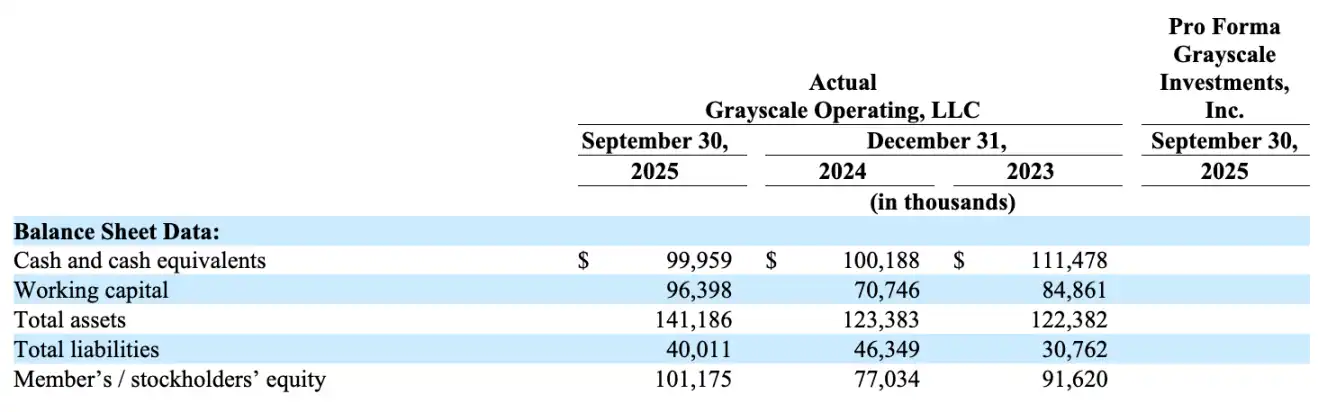
Currently, Grayscale's debt ratio is quite healthy. Despite a decline in revenue and profit, considering the increase in company asset value, decrease in debt, and improvement in profit margin, Grayscale's operational condition is continuously improving.
The S-1 filing also disclosed Grayscale's future development plans, including expanding the types of private funds (introducing more altcoin private investment products); launching active management products to complement passive investment products (ETFs, ETPs); conducting active investments targeting its own investment products, cryptocurrencies, or other assets.
Regarding expanding distribution channels, Grayscale disclosed that it has completed due diligence on three broker-dealers with a total AUM of $14.2 trillion and recently launched Bitcoin and Ethereum mini ETFs on the platform of a large independent broker-dealer with over 17,500 financial advisors and consulting and brokerage assets exceeding $1 trillion. In August of this year, Grayscale partnered with the iCapital Network, a network of 6,700 advisory firms, under which Grayscale will provide digital asset investment channels through its active management strategies to the network companies in the future.
Overall, the information disclosed by Grayscale indicates that the company is a relatively stable asset management firm, with the main revenue source being management fees from investment products, offering limited room for imagination. However, given the precedents of traditional asset management companies going public, the expectations for Grayscale's market value, P/E ratio, etc., are somewhat foreseeable, providing a relatively predictable investment target.
You may also like

Galaxy in-depth report: Is Solana still worth paying attention to?

Young people in South Korea make a "final effort" in the epic bull market

Dialogue with OmenX Founder: Why does the prediction market need an evolution from "spot" to "derivatives"?
When the P2P illicit funds from ten years ago turned into 60,000 bitcoins

Morning News | CME Group launches Nasdaq Cryptocurrency Index futures; Asset management giant Janus Henderson strategically invests in Ethena

Why did Oracle deliver the strongest financial report in history, yet its stock price fell?

Bitcoin Layer 2 Network Botanix: Why Did We Choose to Dissolve?

Morning Report | OpenAI has submitted an S-1 registration statement draft to the U.S. SEC; Morpho completes $175 million financing

Galaxy Deep Research Report: How Hyperliquid's HIP-4 Upgrade Changes the Landscape of Prediction Markets?

Latest research from 13 top universities including Cornell University: The current state, challenges, and misconceptions of the fusion of Crypto and AI
Deconstructing Anthropic: The Best AI Company, Possibly Also a Type of Organizational Invention

Every exchange is a "Universal Exchange."

The counterattack of traditional finance: Alliance chains are quietly reviving
Pantera Capital Partner: How Tokenization is Restructuring the Private Equity and Early Investment Ecosystem?

Mastercard Launches Agent Pay for AI, Plans to Record AI Agent Payment Authorizations on Polygon
Mastercard launched Agent Pay for AI, a new payment protocol designed to help AI agents make small payments such as pay-per-use access to data and APIs. The system plans to record human-granted AI agent permissions on Polygon, focusing on verifiable authorization, identity, and payment controls.

Curve Deploys Llamalend v2 on Optimism With 250,000 OP Incentives
Curve launched Llamalend v2 on Optimism with 250,000 OP incentives from the Optimism Foundation. The upgrade expands Llamalend beyond its earlier crvUSD-focused model, adding broader collateral support, LlamaRisk market reviews, and the ability to use Curve LP tokens as collateral.

Raydium Old Liquidity Pool Reportedly Exploited, With $1.34 Million Moved to Ethereum and Tornado Cash
An old Raydium liquidity pool was reportedly exploited for around $1.34 million in USDC, RAY, and wSOL, with the stolen funds bridged to Ethereum and deposited into Tornado Cash. The incident highlights the tail risks of legacy DeFi pools, old contracts, and cross-chain fund laundering paths.
Kalshi Executive Challenges “SBF Backed AI Unicorns” Narrative, Says Leopold Aschenbrenner Was Key Figure
Kalshi executive John Wang questioned the “SBF backed AI unicorns” narrative, saying Leopold Aschenbrenner was the key figure behind major AI investment decisions.
Galaxy in-depth report: Is Solana still worth paying attention to?
Young people in South Korea make a "final effort" in the epic bull market
Dialogue with OmenX Founder: Why does the prediction market need an evolution from "spot" to "derivatives"?
When the P2P illicit funds from ten years ago turned into 60,000 bitcoins
Morning News | CME Group launches Nasdaq Cryptocurrency Index futures; Asset management giant Janus Henderson strategically invests in Ethena
Why did Oracle deliver the strongest financial report in history, yet its stock price fell?

Popular coins
Latest Crypto News


