
Renowned Crypto Influencer Embroiled in "Donation Fraudgate," Accused of Faking Hong Kong Fire Donation Receipt, Sparking Public Outcry


A serious fire at Wang Fuk House in Tai Po, Hong Kong, has caused hundreds of casualties and property damage. Charitable organizations such as Yan Chai Hospital promptly set up an emergency relief fund to support the affected residents. The cryptocurrency industry has also seen many companies and individuals providing assistance, including industry giants like Binance and Matrixport donating millions of Hong Kong dollars. However, on December 1, a prominent figure in the cryptocurrency community, known as KOL @Elizabethofyou, found herself embroiled in a "Donation Fraud" scandal when the community noticed that the proof of her HK$200,000 donation appeared to be photoshopped.
A "Expose the Fraud" Movement Triggered by a Screenshot
On December 1, Elizabeth, a cryptocurrency influencer with 130,000 followers, posted a tweet on the social media platform X (formerly Twitter), stating that she had donated HK$200,000 to Yan Chai Hospital to support the victims of the Tai Po fire. The tweet included a screenshot of the transaction confirmation and a caption urging others to "show kindness in the face of disaster." The act of kindness quickly garnered over 600,000 views and 1500 likes, initially being seen as a demonstration of positive energy in the industry.
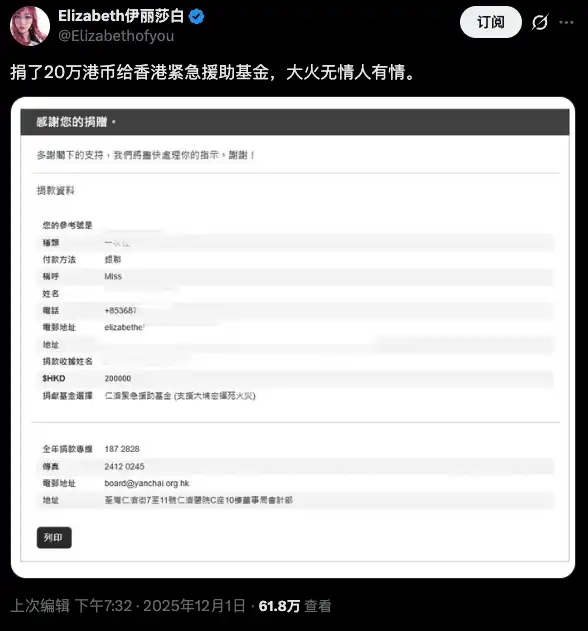
However, public opinion took a sharp turn within hours. Several members of the crypto community on the Twitter platform, such as @CryptoNyaRu and @abyssofgambling, analyzed the screenshot and pointed out multiple suspicious elements:
1. Irregular Font: The number "2" in the amount "200,000" in the screenshot had a noticeably thinner font, inconsistent with the font style of the "Annual Donation Hotline" number below.
2. Misalignment: The amount line and the text below could not be aligned, showing a significant discrepancy in pixel height typical of image editing software (such as Photoshop) manipulation.
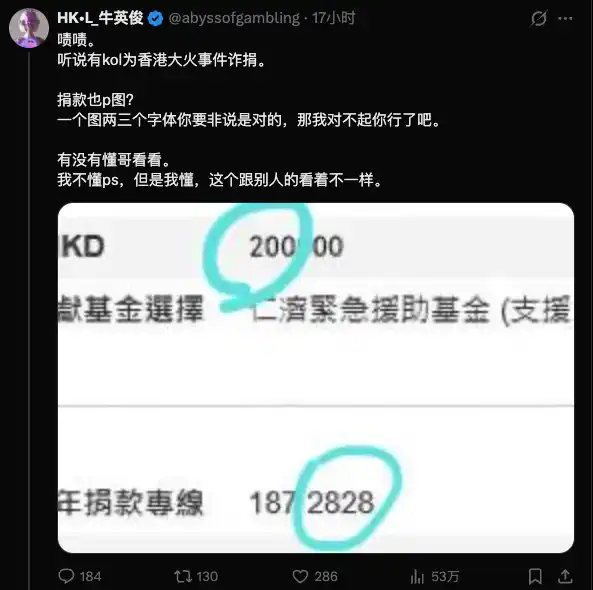
The suspicions quickly escalated, turning the likes into dislikes. The community believed that if this was indeed a fraud, using a significant tragedy to deceive people's compassion was incredibly heinous, and they hoped Elizabeth could provide evidence to prove the authenticity of her donation.
Response from the Involved Party and Escalation of Public Opinion
Faced with overwhelming doubts, Elizabeth released a response video on the evening of the 1st. In the video, she insisted that she had "donated with a clear conscience" and stated that this would be her final response. She then displayed another screenshot as evidence.
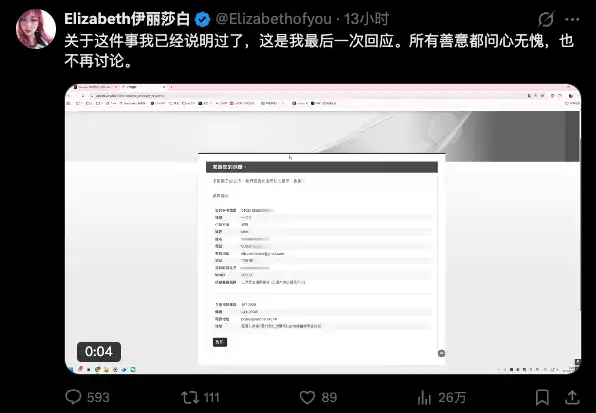
This screenshot is different from the first one. The phone number is different, and the video demonstration is of a static webpage without dynamic refreshing. Additionally, netizens believe that the evidence she provided is not convincing as there is no bank transaction record or an official receipt from Renji Hospital.
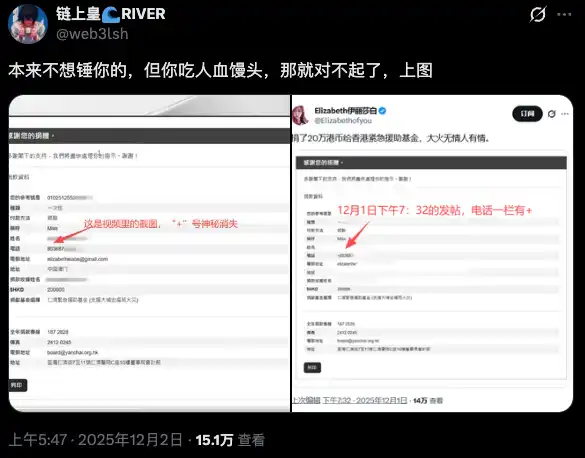
After releasing a response, Elizabeth ignored numerous requests for self-verification in the comments and continued to post commercial ad tweets. This handling of the situation further enraged the public.
According to the Hong Kong Theft Ordinance, if misleading the public through false statements to gain benefits (including advertising collaboration opportunities due to traffic, brand image enhancement, etc.), it may constitute "fraud" or "obtaining property by deception." Upon conviction for such offenses, the maximum penalty can be 10 to 14 years of imprisonment. Netizens have started reaching out to donation organizations for verification and believe that if the fraudulent donation is confirmed, there should be legal consequences. Some Key Opinion Leaders (KOLs) have also compared donation verification evidence for authenticity. As of now, there has been no latest response from donation organizations regarding Elizabeth.
Historical Warning: The Cost of Celebrity "Donation Fraud"
Using charity for false publicity is not uncommon in the history of public figures.
One of the most famous cases is international actress Zhang Ziyi. During the 2008 Wenchuan earthquake, Zhang Ziyi claimed to donate 1 million RMB. However, in 2010, netizens discovered that the actual amount received was only 840,000 RMB, and the whereabouts of the millions of dollars she claimed to have raised in Cannes were unknown.
After the incident broke out, Zhang Ziyi's public image plummeted, facing an unprecedented crisis of trust. Eventually, her agent apologized for "management negligence," made up the shortfall, and hired an auditing firm to audit and disclose the foundation's accounts. Despite taking remedial measures, the "donation fraud" label followed her for many years.
In 2015, well-known actress Yang Mi promised to donate typewriters and white canes to a special education school in Chengdu while promoting the movie "I Am a Witness." However, it wasn't until 2018 that the school stated they never received the supplies.
Yang Mi's studio explained that it was due to the negligence of an "intermediary" that the donation was not fulfilled, and they promptly donated the supplies and publicly apologized. Although it was not legally classified as fraud, the incident was characterized by the public as "hypocritical," greatly undermining her integrity as a public figure.
You may also like

Japan’s Three Megabanks Plan Joint Stablecoin Issuance in Fiscal 2026
MUFG, SMBC, and Mizuho reportedly plan to jointly issue fiat-pegged stablecoins in fiscal 2026, signaling Japan’s growing push into bank-led digital payment infrastructure.

Humanity Discloses H Token Dual-Chain Attack Details, With Losses on Ethereum and BSC Exceeding $36 Million
Humanity said the H token attack across Ethereum and BSC caused more than $36 million in losses after leaked ProxyAdmin keys enabled malicious contract upgrades and token minting.

White House Discusses CLARITY Act With Law Enforcement Ahead of Senate Vote
The White House discussed the CLARITY Act with law enforcement ahead of a Senate vote, focusing on illicit finance risks and developer protections.

$75 billion in foreign capital has fled, and South Korean retail investors have absorbed it all using leverage

Bitcoin Trading Guide 2026: Strategies for Experienced Traders

What Is XAUT and PAXG? Why Tokenized Gold Is Booming in 2026

Cryptocurrency CEXs are flocking to sell US stocks, and traditional brokerages are facing an "uninvited guest."

Will the SpaceX IPO Hurt Bitcoin? Here's What Traders Are Watching
Foreign selling in the South Korean stock market accelerates, with cumulative net sales reportedly reaching $75 billion this year
On June 9, The Kobeissi Letter, citing Goldman Sachs data, reported that global investors are selling South Korean stocks at an unusually rapid pace. In the latest trading session, foreign investors sold about $801 million worth of Kospi constituent stocks again; total foreign outflows last week reached about $10 billion, and the market has been in net foreign selling on nearly every trading day over the past month. According to the data cited in the report, foreign investors have sold about $75 billion worth of South Korean stocks so far this year. Meanwhile, South Korean retail and institutional investors together recorded roughly $69 billion in net buying over the same period, suggesting that the market’s main buying support has come from domestic capital rather than returning overseas funds. The information currently disclosed still mainly comes from The Kobeissi Letter’s retelling and Goldman Sachs data summaries, while public details on the statistical period and the specific definition of “selling” remain relatively limited.

Fortune Warns of Strategy’s Financing Structure Risks as Bitcoin Premium Narrows
Fortune warned that Strategy’s Bitcoin treasury model faces growing financing risks as MSTR’s net asset premium narrows and preferred stock dividend pressure increases.

Ferrari Challenge Le Mans: Carl Moon to Dominate in WEEX Livery

Sahara AI Responds to SAHARA’s Sharp Drop: No Contract or Product Security Issues Found, Internal Investigation Underway
Sahara AI responded to SAHARA’s 60% price drop, saying no token contract or product security issues have been found and an internal investigation is underway.

WEEX Deposit/Withdrawal Dynamic Island: Your Asset Status, Always in Sight
Scaling Crypto Derivatives: The Digital Asset Infrastructure Behind High-Volume Trading
In the fast-moving digital asset ecosystem, derivatives platforms face an extreme architectural test. High-leverage futures markets demand more than just standard security—they require absolute operational precision, zero-latency matching engines, and ironclad structural scalability, all while navigating intense market volatility.
As global platforms scale to meet these demands, the industry is shifting away from rigid, monolithic setups toward a more agile, "decoupled" infrastructure philosophy.
The Blueprint for High-Volume Copy TradingFor elite global exchanges like WEEX (founded in 2018), this architectural choice becomes critical when scaling high-volume retail features like social copy trading. When thousands of users automatically mirror the real-time strategies of elite traders simultaneously, it triggers sudden, monumental spikes in concurrent transactional volume.
To prevent execution latency or settlement bottlenecks during these peak volatility events, a platform's primary engine must remain entirely dedicated to risk management, copy-trade synchronization, and order matching.
The Architectural Rule: New-generation platforms must separate front-end user execution engines from heavy backend infrastructural overhead to eliminate operational friction.
By separating these layers, platforms can maintain complete sovereignty over their trading environments and user experiences while strategically aligning with institutional-grade infrastructure ecosystems. This strategic framework allows modern exchanges to leverage advanced Digital Asset Custody infrastructure such as Cobo’s behind the scenes, ensuring that backend wallet management scales elastically alongside trading spikes.
Capitalizing on Market Momentum and 400× LeverageIn a derivatives arena where platforms offer up to 400× leverage on perpetual contracts, capital efficiency and market agility are core business metrics. To capture market momentum, an exchange needs the ability to rapidly expand its asset offerings, supporting everything from legacy crypto assets to sudden, trending altcoins across a massive library of trading pairs.
Adopting a flexible, scalable Wallet-as-a-Service (WaaS) solution such as Cobo’s could completely rewrite the development timeline for high-growth exchanges. Instead of spending months of engineering capital building out custom backend wallet architectures for every new blockchain network, platforms can deploy localized infrastructure in days.
This agility allows platforms to instantly scale their listings to over a thousand trading pairs without compromising security or delaying time-to-market. It mirrors the exact operational advantages seen during high-velocity market events, similar to how advanced wallet infrastructure empowers platforms during sudden asset surges; allowing exchanges to pass that speed and liquidity directly to their global user base.
A Mature Foundation for GrowthThe synergy between trusted infrastructure ecosystems and global trading platforms represents the natural evolution of a maturing crypto market. As WEEX continues to scale its global spot and derivatives offerings for over 6 million users, adopting robust backend paradigms proves that platforms no longer have to compromise between cutting-edge trading velocity and uncompromised structural security.

Morning Report | BitMine increased its holdings by 126,971 ETH last week; trader Eugene announced his exit from the crypto market

Wang Chuan: How can one not feel anxious after the neighbor Old Wang made thirty times profit by investing in storage stocks? (Seven) - A quarter-century cycle

Get Paid to Onboard? Try WEEX’s New Homepage with Rewards for Registration, Deposit & Trade
WEEX Custom Layout: Build Your Perfect Trading Workspace in Seconds
Japan’s Three Megabanks Plan Joint Stablecoin Issuance in Fiscal 2026
MUFG, SMBC, and Mizuho reportedly plan to jointly issue fiat-pegged stablecoins in fiscal 2026, signaling Japan’s growing push into bank-led digital payment infrastructure.
Humanity Discloses H Token Dual-Chain Attack Details, With Losses on Ethereum and BSC Exceeding $36 Million
Humanity said the H token attack across Ethereum and BSC caused more than $36 million in losses after leaked ProxyAdmin keys enabled malicious contract upgrades and token minting.
White House Discusses CLARITY Act With Law Enforcement Ahead of Senate Vote
The White House discussed the CLARITY Act with law enforcement ahead of a Senate vote, focusing on illicit finance risks and developer protections.
$75 billion in foreign capital has fled, and South Korean retail investors have absorbed it all using leverage
Bitcoin Trading Guide 2026: Strategies for Experienced Traders
What Is XAUT and PAXG? Why Tokenized Gold Is Booming in 2026


