
Solana Ecosystem Civil War Erupts: Jupiter and Kamino Fall Out, Foundation Urges Peace




Original Title: "Solana's Top Two Lending Protocols Clash, Foundation Steps In to Mediate"
Original Author: Azuma, Odaily Planet Daily
This past weekend, the top two lending protocols on Solana, Jupiter Lend and Kamino, got into a heated dispute.
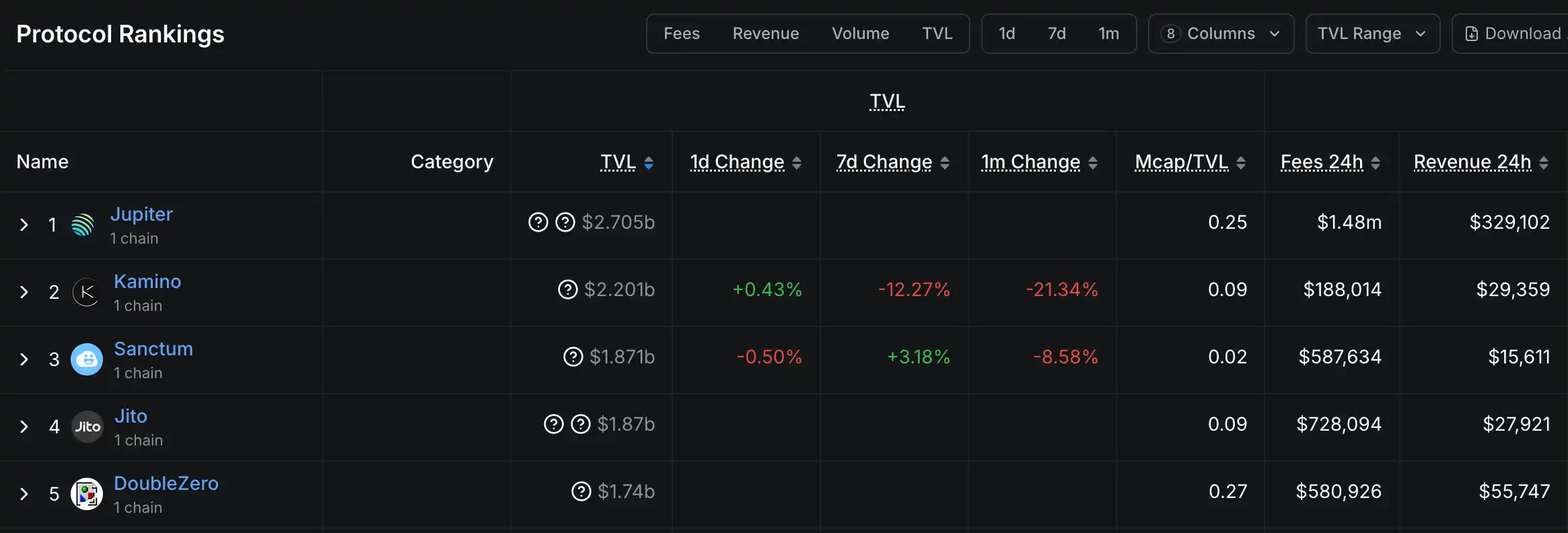
· Odaily Note: According to Defillama data, Jupiter and Kamino are the two protocols with the highest Total Value Locked (TVL) in the Solana ecosystem.
Event Background: Jupiter's Deleted Tweet
The root of the conflict can be traced back to August of this year when Jupiter's official account, prior to the launch of its lending product Jupiter Lend, repeatedly emphasized the product's "risk isolation" feature (related posts have been deleted), meaning there would be no risk cross-contamination between different lending pools.
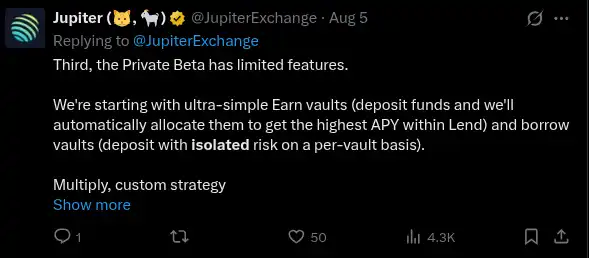
However, the design of Jupiter Lend post-launch did not align with the market's common understanding of a risk-isolation model. In the general market view, a DeFi lending pool considered to have risk isolation is a structure that partitions risks of different assets or markets from each other, preventing a single asset default or a market collapse from affecting the entire protocol's lending pool. The main features of this structure include:
· Pool Segregation: Different asset types (such as stablecoins, volatile assets, NFT collateral, etc.) are allocated to independent lending pools, each pool having separate liquidity, debt, and risk parameters.
· Collateral Segregation: Users can only use assets within the same pool as collateral to borrow other assets, cutting off cross-pool risk transmission.
However, Jupiter Lend actually supports using re-collateralization (reusing collateral deposited elsewhere in the protocol) to enhance capital efficiency, meaning that the collateral deposited in the treasury is not completely isolated from each other. Samyak Jain, co-founder of Jupiter, explained that the lending pools in Jupiter Lend are "in a sense 'isolated' as each pool has its own configuration, cap, liquidation threshold, liquidation penalty, etc., and the re-collateralization mechanism is just to optimize capital efficiency.
While Jupiter has a more detailed explanation in its product documentation about Jupiter Lend, objectively speaking, the early promotional material did mention "risk isolation," which indeed deviated somewhat from the widely accepted market understanding, raising suspicions of misleading information.
Clash Erupts: Kamino Launches an Attack
On December 6, Kamino co-founder Marius Ciubotariu took this opportunity to criticize Jupiter Lend and banned Kamino's migration tool to Jupiter Lend.
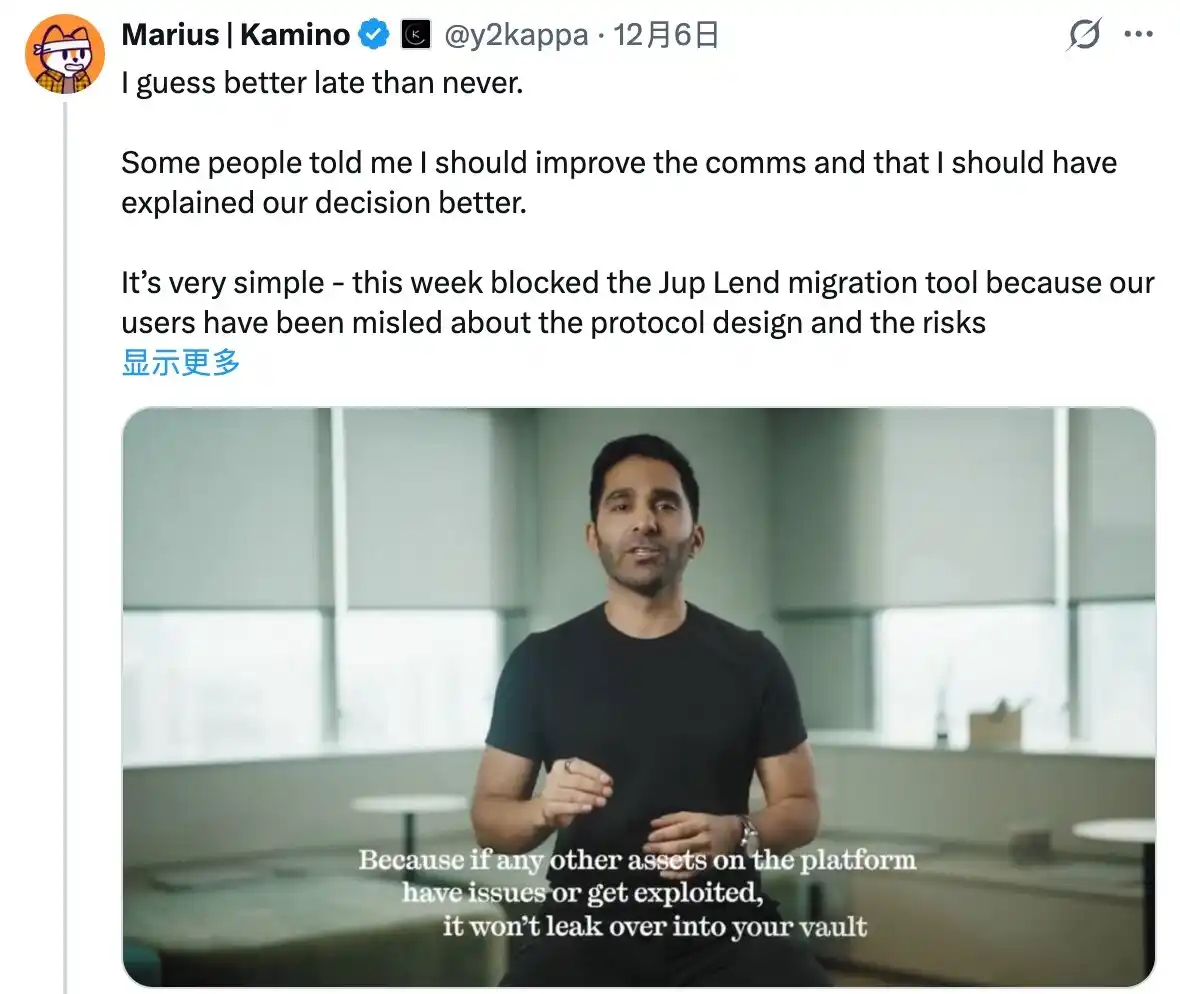
Marius stated: "Jupiter Lend repeatedly claims that there is no cross-contamination between assets, which is completely unfounded. In reality, in Jupiter Lend, if you deposit SOL and borrow USDC, your SOL will be lent to other users engaging in yield farming using JupSOL and INF, and you will bear all the risks of these yield farming collapses or asset defaults. There is no isolation measure here, and there is complete cross-contamination, contrary to the advertising and what people have been told... In traditional finance (TradFi) and decentralized finance (DeFi), information such as whether collateral is rehypothecated or whether there is contagion risk is important information that must be clearly disclosed, and no one should provide vague explanations about it."
After Kamino's challenge, discussions surrounding the design of Jupiter Lend quickly ignited the community. Some agreed that Jupiter was suspected of false advertising — for example, Penis Ventures CEO 8bitpenis.sol ranted that Jupiter had been lying openly from the start, deceiving users; while others believed that Jupiter Lend's design model balanced security and efficiency, and Kamino's attack was merely for market competition with impure motives — such as overseas KOL letsgetonchain, who stated, "Jupiter Lend's design achieves both capital efficiency in a money pool model and some risk management capabilities of a modular lending protocol... Kamino cannot stop people from migrating to better technology."
Under intense pressure, the Jupiter team quietly deleted the early posts, but this triggered an even larger scale of FUD. Subsequently, Jupiter's Chief Operating Officer Kash Dhanda also came forward to admit that the team's previous claims on social media about Jupiter Lend having "zero contagion risk" were inaccurate and apologized, stating that a correction statement should have been issued simultaneously with the post deletion.
Core Contradiction: The Definition of "Risk Isolation"
Amidst the current community's divergent attitudes, the fundamental disagreement seems to lie in the different groups' varying definitions of the term "Risk Isolation."
From Jupiter and its supporters' perspective, "Risk Isolation" is not a completely static concept, leaving room for certain design considerations. Although Jupiter Lend does not follow the typical risk isolation model, it also does not fall under a fully open fund pool model. While sharing a common permissive liquidity layer for re-collateralization, each lending pool can be independently configured with its own asset limits, liquidation thresholds, and liquidation penalties.
Conversely, in Kamino and its supporters' view, any allowance for re-collateralization is a complete denial of "Risk Isolation," and project teams should not resort to vague disclosures and false marketing to deceive users.
Upper-layer Consciousness: Some Watch the Fire Burn, While Others Try to Extinguish It
Aside from the controversy between the two sides and within the community, another noteworthy aspect of this turmoil is the varied upper-layer attitudes within the Solana ecosystem.
Firstly, there is Multicoin, the most influential voice within the Solana ecosystem. As an investor in Kamino, Multicoin partner Tushar Jain directly questioned Jupiter's actions, stating that they are either "incompetent or malicious, but neither possibility is forgivable" — objectively, his statement significantly exacerbated the situation.
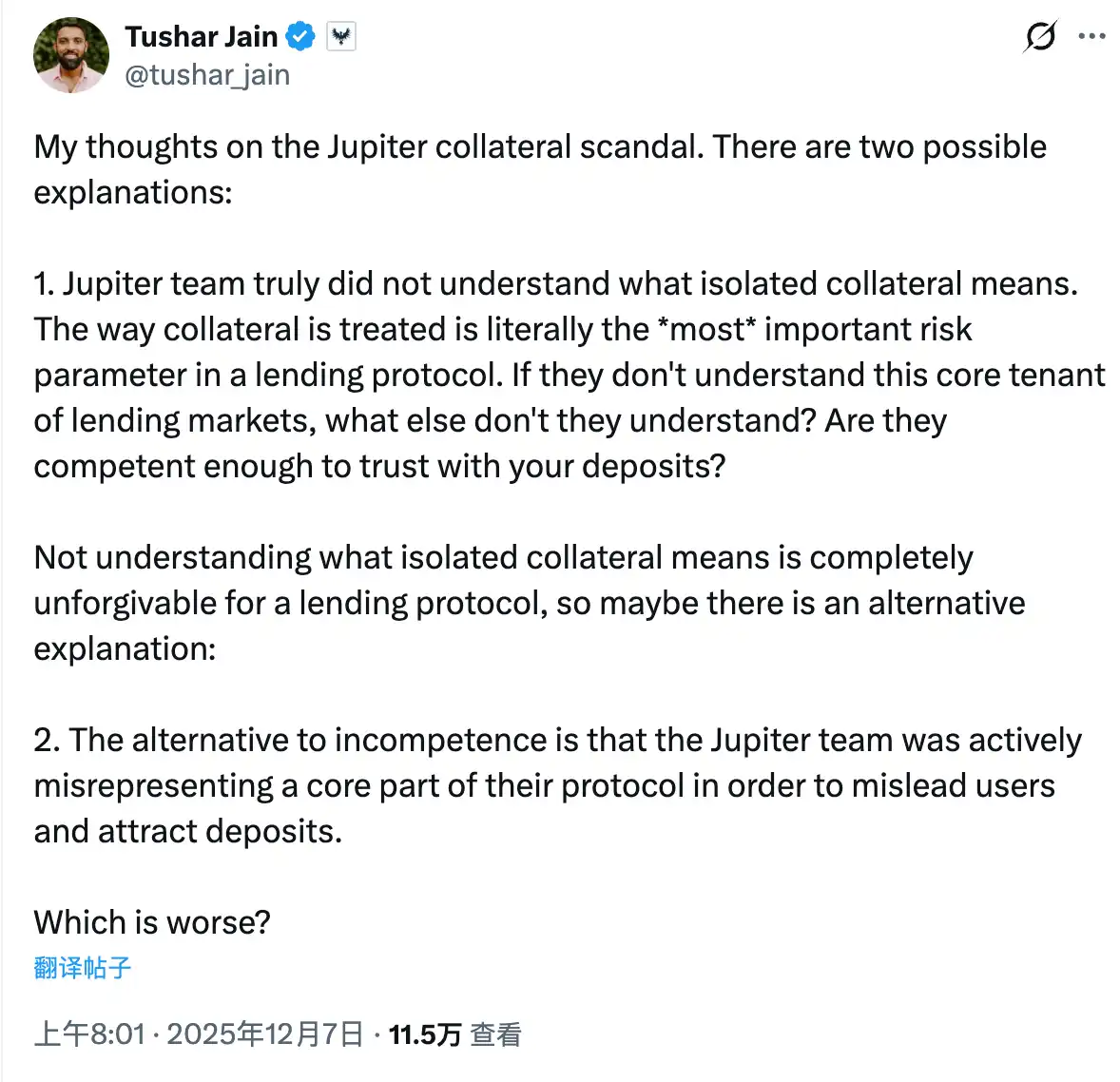
Tushar stated: "There are two possible explanations for the controversy surrounding Jupiter Lend. One is that the Jupiter team genuinely does not understand the meaning of isolated collateral. The collateral handling is the most critical risk parameter in a lending protocol. If they do not even grasp this core principle of the lending market, what else have they misunderstood? Is their expertise sufficient to reassure depositors? Not understanding the meaning of isolated collateral in a lending protocol is entirely unforgivable. The other possibility is that the Jupiter team is not incompetent but deliberately distorting a core part of their protocol to deceive users and attract deposits."
Evidently, Tushar's motives are very clear: to take this opportunity to assist Kamino in attacking its competitors.
Another important statement from the upper-level consciousness comes from the Solana Foundation. As the parent ecosystem, Solana clearly does not want to see the two main players in the ecosystem overly confrontational, which would ultimately lead to the ecosystem as a whole falling into internal strife.
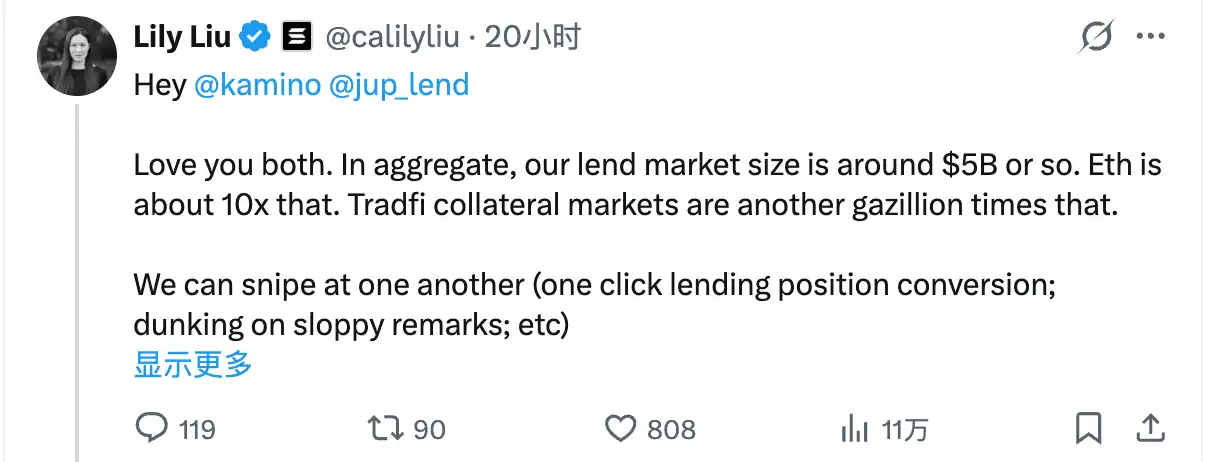
Yesterday afternoon, Solana Foundation President Lily Liu posted on Platform X calling on the two projects and advocating for peace, saying: "Love you guys. Overall, our lending market currently has a size of about $5 billion, while Ethereum's ecosystem is roughly 10 times that size. As for the collateral market in traditional finance, it is many times larger than this number. We can choose to attack each other, but we can also choose to look further ahead—first unite to capture market share from the entire crypto market, and then together march into the vast world of traditional finance.
To sum it up simply—Stop quarreling, or else Ethereum will benefit from our quarrel!
The Logic Behind It, the Battle for Solana's Lending Leader
Looking at the development and market environment data of Jupiter Lend and Kamino, although this storm seemed to have arisen suddenly, it appears to be an inevitable collision that was only a matter of time.
On one hand, Kamino (highlighted in red in the image below) had long held the position of the leading lender in the Solana ecosystem, but since Jupiter Lend (highlighted in blue in the image below) went live, it has captured a large market share and has become the only entity in the Solana ecosystem that can challenge the former.
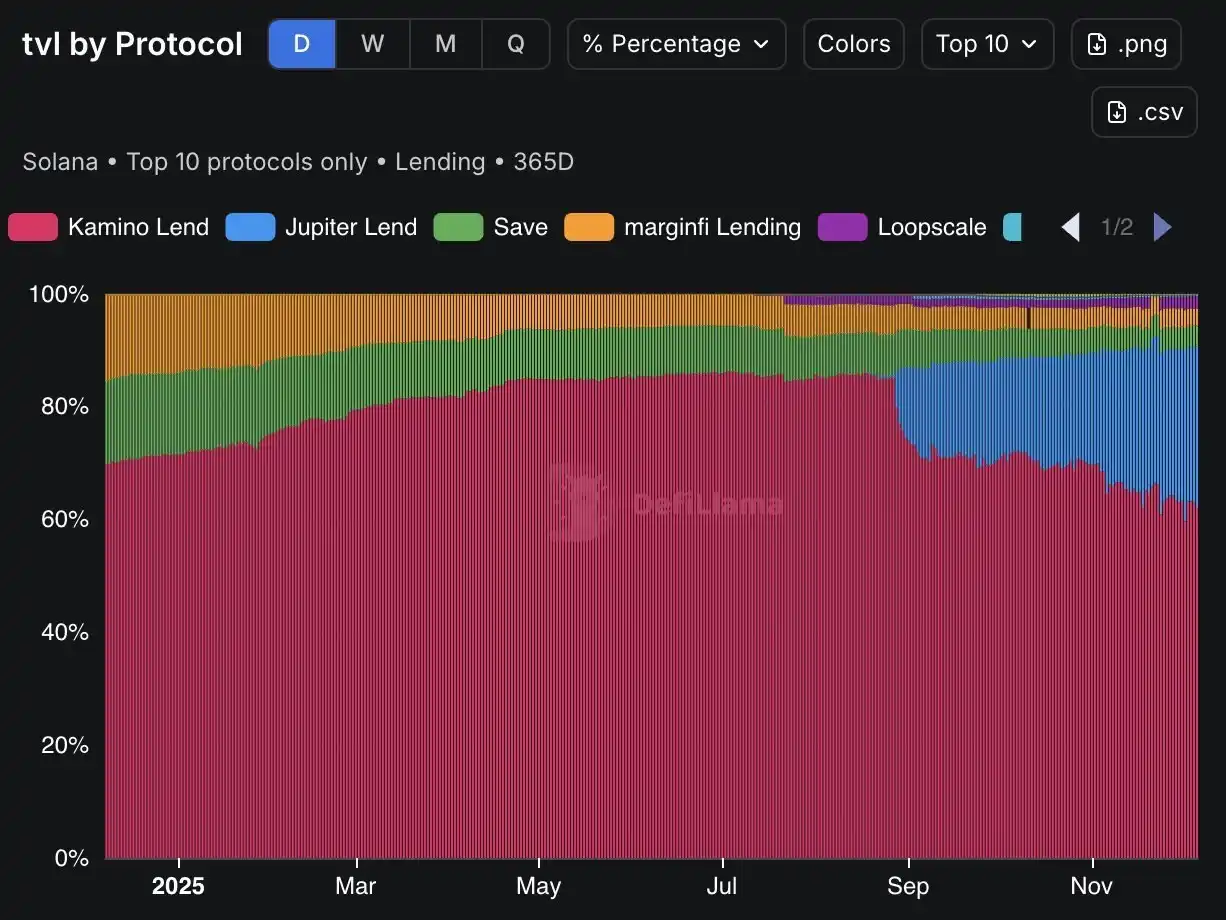
On the other hand, since the bloodbath on October 11, the market liquidity has significantly tightened, the overall TVL of the Solana ecosystem has continued to decline, and multiple projects collapsing due to rug pulls have made the DeFi market extremely sensitive to "security."
During a more favorable market environment with sufficient incremental funding, Jupiter Lend and Kamino coexisted relatively peacefully since there was money to be made by both parties, and it seemed like they would only continue to earn more... But as the market shifted to a zero-sum game, the competition between the two sides became more intense, and security issues conveniently became the most effective attack surface—although Jupiter Lend has never experienced a security breach in its history, mere suspicions about its design are enough to raise users' vigilance.
Perhaps to Kamino, now is the perfect opportunity to severely weaken their opponent.
You may also like

Japan’s Three Megabanks Plan Joint Stablecoin Issuance in Fiscal 2026
MUFG, SMBC, and Mizuho reportedly plan to jointly issue fiat-pegged stablecoins in fiscal 2026, signaling Japan’s growing push into bank-led digital payment infrastructure.

Humanity Discloses H Token Dual-Chain Attack Details, With Losses on Ethereum and BSC Exceeding $36 Million
Humanity said the H token attack across Ethereum and BSC caused more than $36 million in losses after leaked ProxyAdmin keys enabled malicious contract upgrades and token minting.

White House Discusses CLARITY Act With Law Enforcement Ahead of Senate Vote
The White House discussed the CLARITY Act with law enforcement ahead of a Senate vote, focusing on illicit finance risks and developer protections.

$75 billion in foreign capital has fled, and South Korean retail investors have absorbed it all using leverage

Bitcoin Trading Guide 2026: Strategies for Experienced Traders

What Is XAUT and PAXG? Why Tokenized Gold Is Booming in 2026

Cryptocurrency CEXs are flocking to sell US stocks, and traditional brokerages are facing an "uninvited guest."

Will the SpaceX IPO Hurt Bitcoin? Here's What Traders Are Watching
Foreign selling in the South Korean stock market accelerates, with cumulative net sales reportedly reaching $75 billion this year
On June 9, The Kobeissi Letter, citing Goldman Sachs data, reported that global investors are selling South Korean stocks at an unusually rapid pace. In the latest trading session, foreign investors sold about $801 million worth of Kospi constituent stocks again; total foreign outflows last week reached about $10 billion, and the market has been in net foreign selling on nearly every trading day over the past month. According to the data cited in the report, foreign investors have sold about $75 billion worth of South Korean stocks so far this year. Meanwhile, South Korean retail and institutional investors together recorded roughly $69 billion in net buying over the same period, suggesting that the market’s main buying support has come from domestic capital rather than returning overseas funds. The information currently disclosed still mainly comes from The Kobeissi Letter’s retelling and Goldman Sachs data summaries, while public details on the statistical period and the specific definition of “selling” remain relatively limited.

Fortune Warns of Strategy’s Financing Structure Risks as Bitcoin Premium Narrows
Fortune warned that Strategy’s Bitcoin treasury model faces growing financing risks as MSTR’s net asset premium narrows and preferred stock dividend pressure increases.

Ferrari Challenge Le Mans: Carl Moon to Dominate in WEEX Livery

Sahara AI Responds to SAHARA’s Sharp Drop: No Contract or Product Security Issues Found, Internal Investigation Underway
Sahara AI responded to SAHARA’s 60% price drop, saying no token contract or product security issues have been found and an internal investigation is underway.

WEEX Deposit/Withdrawal Dynamic Island: Your Asset Status, Always in Sight
Scaling Crypto Derivatives: The Digital Asset Infrastructure Behind High-Volume Trading
In the fast-moving digital asset ecosystem, derivatives platforms face an extreme architectural test. High-leverage futures markets demand more than just standard security—they require absolute operational precision, zero-latency matching engines, and ironclad structural scalability, all while navigating intense market volatility.
As global platforms scale to meet these demands, the industry is shifting away from rigid, monolithic setups toward a more agile, "decoupled" infrastructure philosophy.
The Blueprint for High-Volume Copy TradingFor elite global exchanges like WEEX (founded in 2018), this architectural choice becomes critical when scaling high-volume retail features like social copy trading. When thousands of users automatically mirror the real-time strategies of elite traders simultaneously, it triggers sudden, monumental spikes in concurrent transactional volume.
To prevent execution latency or settlement bottlenecks during these peak volatility events, a platform's primary engine must remain entirely dedicated to risk management, copy-trade synchronization, and order matching.
The Architectural Rule: New-generation platforms must separate front-end user execution engines from heavy backend infrastructural overhead to eliminate operational friction.
By separating these layers, platforms can maintain complete sovereignty over their trading environments and user experiences while strategically aligning with institutional-grade infrastructure ecosystems. This strategic framework allows modern exchanges to leverage advanced Digital Asset Custody infrastructure such as Cobo’s behind the scenes, ensuring that backend wallet management scales elastically alongside trading spikes.
Capitalizing on Market Momentum and 400× LeverageIn a derivatives arena where platforms offer up to 400× leverage on perpetual contracts, capital efficiency and market agility are core business metrics. To capture market momentum, an exchange needs the ability to rapidly expand its asset offerings, supporting everything from legacy crypto assets to sudden, trending altcoins across a massive library of trading pairs.
Adopting a flexible, scalable Wallet-as-a-Service (WaaS) solution such as Cobo’s could completely rewrite the development timeline for high-growth exchanges. Instead of spending months of engineering capital building out custom backend wallet architectures for every new blockchain network, platforms can deploy localized infrastructure in days.
This agility allows platforms to instantly scale their listings to over a thousand trading pairs without compromising security or delaying time-to-market. It mirrors the exact operational advantages seen during high-velocity market events, similar to how advanced wallet infrastructure empowers platforms during sudden asset surges; allowing exchanges to pass that speed and liquidity directly to their global user base.
A Mature Foundation for GrowthThe synergy between trusted infrastructure ecosystems and global trading platforms represents the natural evolution of a maturing crypto market. As WEEX continues to scale its global spot and derivatives offerings for over 6 million users, adopting robust backend paradigms proves that platforms no longer have to compromise between cutting-edge trading velocity and uncompromised structural security.

Morning Report | BitMine increased its holdings by 126,971 ETH last week; trader Eugene announced his exit from the crypto market

Wang Chuan: How can one not feel anxious after the neighbor Old Wang made thirty times profit by investing in storage stocks? (Seven) - A quarter-century cycle

Get Paid to Onboard? Try WEEX’s New Homepage with Rewards for Registration, Deposit & Trade
WEEX Custom Layout: Build Your Perfect Trading Workspace in Seconds
Japan’s Three Megabanks Plan Joint Stablecoin Issuance in Fiscal 2026
MUFG, SMBC, and Mizuho reportedly plan to jointly issue fiat-pegged stablecoins in fiscal 2026, signaling Japan’s growing push into bank-led digital payment infrastructure.
Humanity Discloses H Token Dual-Chain Attack Details, With Losses on Ethereum and BSC Exceeding $36 Million
Humanity said the H token attack across Ethereum and BSC caused more than $36 million in losses after leaked ProxyAdmin keys enabled malicious contract upgrades and token minting.
White House Discusses CLARITY Act With Law Enforcement Ahead of Senate Vote
The White House discussed the CLARITY Act with law enforcement ahead of a Senate vote, focusing on illicit finance risks and developer protections.
$75 billion in foreign capital has fled, and South Korean retail investors have absorbed it all using leverage
Bitcoin Trading Guide 2026: Strategies for Experienced Traders
What Is XAUT and PAXG? Why Tokenized Gold Is Booming in 2026


