
The market volatility continues. How to determine when the pullback is over?


Original Author: Murphy, On-chain Data Analyst
How to Determine if a Pullback is About to End?
There are many methods to determine if a short-term pullback is about to end. As mentioned before, analysis can be conducted from different perspectives such as chip structure, financial pressure, sentiment feedback, etc. Today, I will share another method that I often use and find very effective, which is to observe the cost basis changes of different time cohorts as a reference point.
Before discussing the logic, let's first look at a case study—the bottom judgment of a large cycle
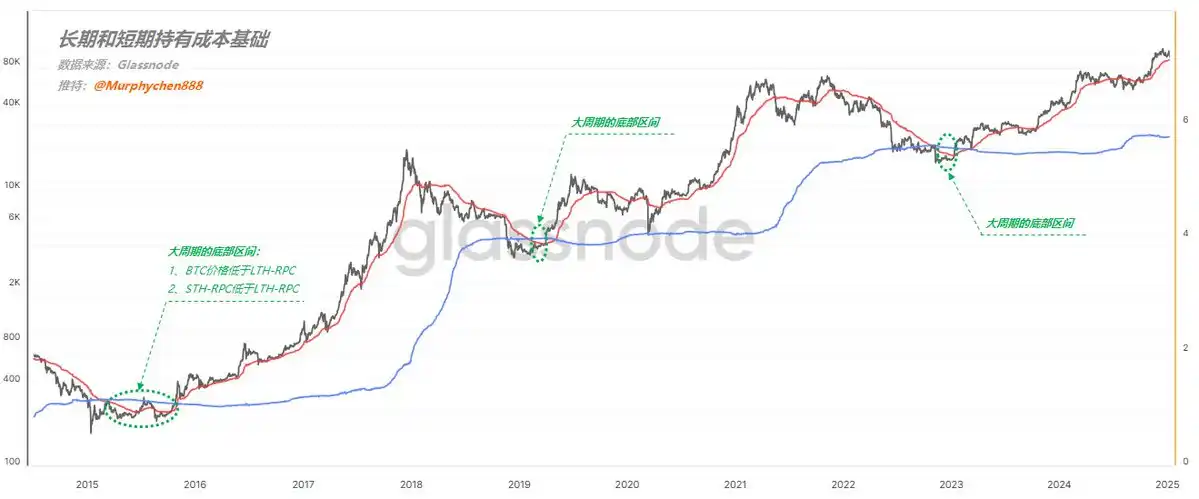
In Figure 1 below, the blue line represents Long-Term Holder's Average Cost Basis (LTH-RPC), the red line represents Short-Term Holder's Average Cost Basis (STH-RPC), and the black line is BTC's price.
(Figure 1)
Pay attention to the area I have circled in green with a dotted line. As long as the following 2 conditions are met simultaneously:
- Condition 1, BTC price is below LTH-RPC
- Condition 2, STH-RPC is below LTH-RPC
This stage is the bottom range of the large cycle and is also an excellent opportunity to buy the dip!
The underlying logic is as follows:
First, when the BTC price falls below the LTH-RPC, it means that the average cost of long-term holders is at a loss. This indicates that the price is severely undervalued, and the market bubble has almost completely burst.
Second, in the vast majority of time, the longer the chip holding period, the lower the relative cost. Therefore, it is extremely rare for STH-RPC to be lower than LTH-RPC.
It indicates that during the price decline, there were a large number of loss-exiting short-term holders, but new short-term holders entered to buy the dip. After frequent turnover, the cost of short-term chips was actually pulled below the cost of long-term chips. This is a phase of oversold prices, signaling the bottom of the panic sentiment. Following the logic above, we can also apply the same reasoning to determine the duration of a bull market pullback.
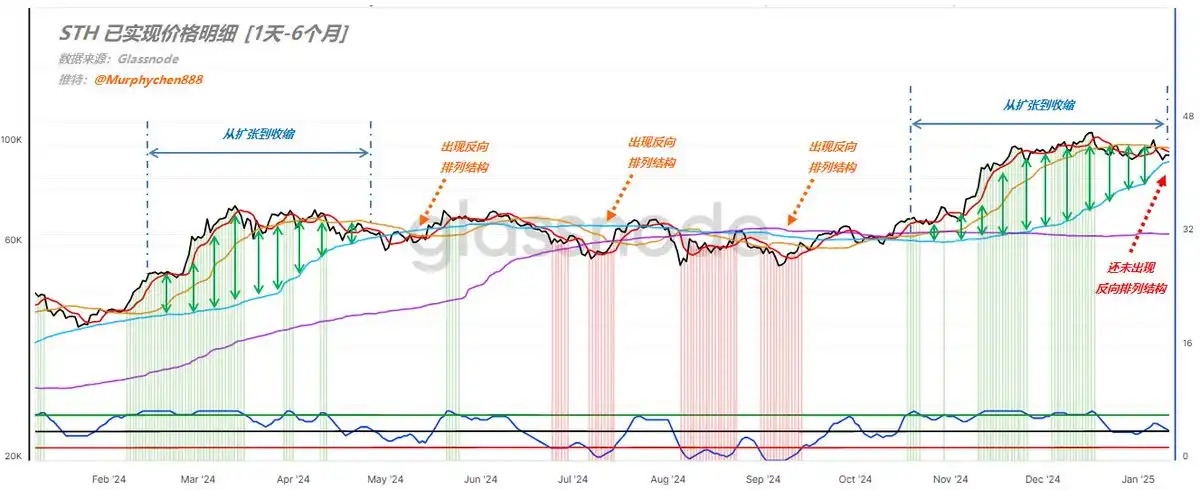
Figure 2 below lists the cost bases for: 1d-1w (red line), 1w-1m (yellow line), 1m-3m (blue line), 3m-6m (purple line)
(Figure 2)
First, let's look at February to May 24th, which happens to be the process from the start of a trend to decay and a pullback. The entire process is accompanied by the widening and narrowing of the distance between the blue line and the red line (as indicated by the green arrows in the image);
Eventually, the blue line ran to the top, while the red line was at the bottom, meaning that the relative short-term cost of chips was lower than the relative long-term cost of chips. I call this phenomenon the "reverse arrangement structure" of long-term and short-term costs.
I marked three points in the image with orange dashed lines, all of which show the formation of a blue, yellow, red arrangement from top to bottom, or a purple, blue, yellow, red arrangement, representing the relative bottoms during pullbacks.
So, the current trend is also transitioning from rapid expansion to gradual contraction, but the blue line is still below. If we are to see a market restart in the short term, perhaps a "reverse arrangement structure" needs to be formed first. However, after this period of turnover, the blue line is already very close to the red and yellow 2 lines. As long as there is another period of consolidation, the structure can form, thereby meeting the conditions for forming a relative bottom.
PS: Of course, it would be best to form a purple, blue, yellow, red "reverse arrangement structure," but this would require a longer turnover time (at least 4-5 months).
Summary:
Based on the change in the cost base of different time groups as the basis for judging the time of a pullback, the higher the relative cost of long-term chips, the closer we are to the bottom once a blue, yellow, red "reverse arrangement structure" is formed from top to bottom. This indicates that turnover is sufficient, sentiment is close to the bottom, and the pullback time is coming to an end.
The content shared in this article is for communication and research purposes only and should not be construed as investment advice.
You may also like

Morning Report | Strategy sold 32 BTC and over 800,000 shares of MSTR last week; Binance officially announced its U.S. stock trading portal; Polymarket reached an exclusive partnership with OneFootball

Zhou Hang: How much is SpaceX really worth?

IOSG: From Coinbase to Upbit: How a Token Completes a 28-Day Journey of Taking Over

Exclusive Interview with Alpaca CEO: What is the background of the US stock underlying service provider behind Binance and Bitget?

Variant: Three types of L1 assets are highly likely to become the main means of value storage

Does the performance on Perp DEX become an "invisible threshold" and "amplifier" for new coins to go live on CEX?

a16z Crypto's latest article: Why do we need to predict the market?

Strategy cashes out 2.5 million USD, but Bitcoin's market value dropped by 80 billion USD in one day

Collective Change of Ownership for Crypto Exchanges? The Positioning Competition Among South Korean Financial Giants

WEEXPERIENCE Trading Bootcamp in Poland: How WEEX & FireCrew Are Making Crypto Trading Accessible to Everyone

Paris Reigns Supreme: How PSG Crushed Arsenal’s Dream in a Historic UCL Final Thriller

Full text and analysis of the speech by the CEO of SanDisk at the 42nd Annual Strategic Decision Conference of Bernstein

TaiJi completes $3.5 million strategic financing, with investments from Castrum Capital, Becker Ventures, and Coinvestor Ventures

Bitcoin Stuck Near $73K? How Traders Are Finding Rewards in a Sideways June Market

What Is a Bitcoin ETF? A Simple Guide for 2026

Best AI Crypto Coins 2026: Top 7 Tokens Ranked by Data

How to Stake Solana: A Step-by-Step Guide for 2026

Guaranteed Price Now Live on WEEX: Execute with Greater Precision
Morning Report | Strategy sold 32 BTC and over 800,000 shares of MSTR last week; Binance officially announced its U.S. stock trading portal; Polymarket reached an exclusive partnership with OneFootball
Zhou Hang: How much is SpaceX really worth?
IOSG: From Coinbase to Upbit: How a Token Completes a 28-Day Journey of Taking Over
Exclusive Interview with Alpaca CEO: What is the background of the US stock underlying service provider behind Binance and Bitget?
Variant: Three types of L1 assets are highly likely to become the main means of value storage
Does the performance on Perp DEX become an "invisible threshold" and "amplifier" for new coins to go live on CEX?


