
Why is it said that a prediction market is not really a gambling platform?

Original Article Title: "Why Prediction Markets Really Aren't Gambling Platforms"
Original Article Author: Planet Xiaohua, Odaily Planet Daily
Over the past two years, Prediction Markets have quickly moved from a fringe concept in the crypto community to the mainstream vision of tech venture capital and financial capital.
Compliance newcomer Kalshi recently completed a $1 billion Series E financing, with a post-investment valuation of $11 billion. The investment lineup includes the most influential capital entities such as Paradigm, Sequoia, a16z, Meritech, IVP, ARK Invest, CapitalG, Y Combinator, and others.
Leading the race, Polymarket achieved a $9 billion valuation with strategic investment from ICE, and then secured a $12 billion valuation with a $1.5 billion round led by Founders Fund, and is currently raising further funds at a $15 billion valuation.
Despite such intense capital inflow, every time we publish an in-depth article on prediction markets, the comments section cannot escape the remark: "It's just a gambling facade."
Indeed, in fields like sports that are easily comparable, prediction markets and gambling platforms do have similarities in superficial gameplay. However, at a more fundamental and broader level, the two have a structural difference in their operational logic.
A deeper reality is: with top-tier capital entering the scene, they will drive the incorporation of this "structural difference" into regulatory rules, making it a new industry language. Capital is not betting on gambling but on the value of the infrastructure of a new asset class, Event Derivatives Trading Platforms (EDTP).
From a regulatory perspective:
U.S. gambling market = State-level regulation (significant individual differences), high taxes (even a major source of revenue in many states), heavy compliance, numerous restrictions;
New prediction market = Financial derivatives trading platform, federal regulation (CFTC/SEC), nationally recognized, unlimited scale, lighter tax regime.
In short: The boundary of an asset class is never an academic discussion or a philosophical definition but a power distribution between regulation and capital.
1. What is a Structural Difference?
Let's first clarify the objective facts: Why is prediction market not gambling? Because at their most fundamental level, they are two completely different systems.
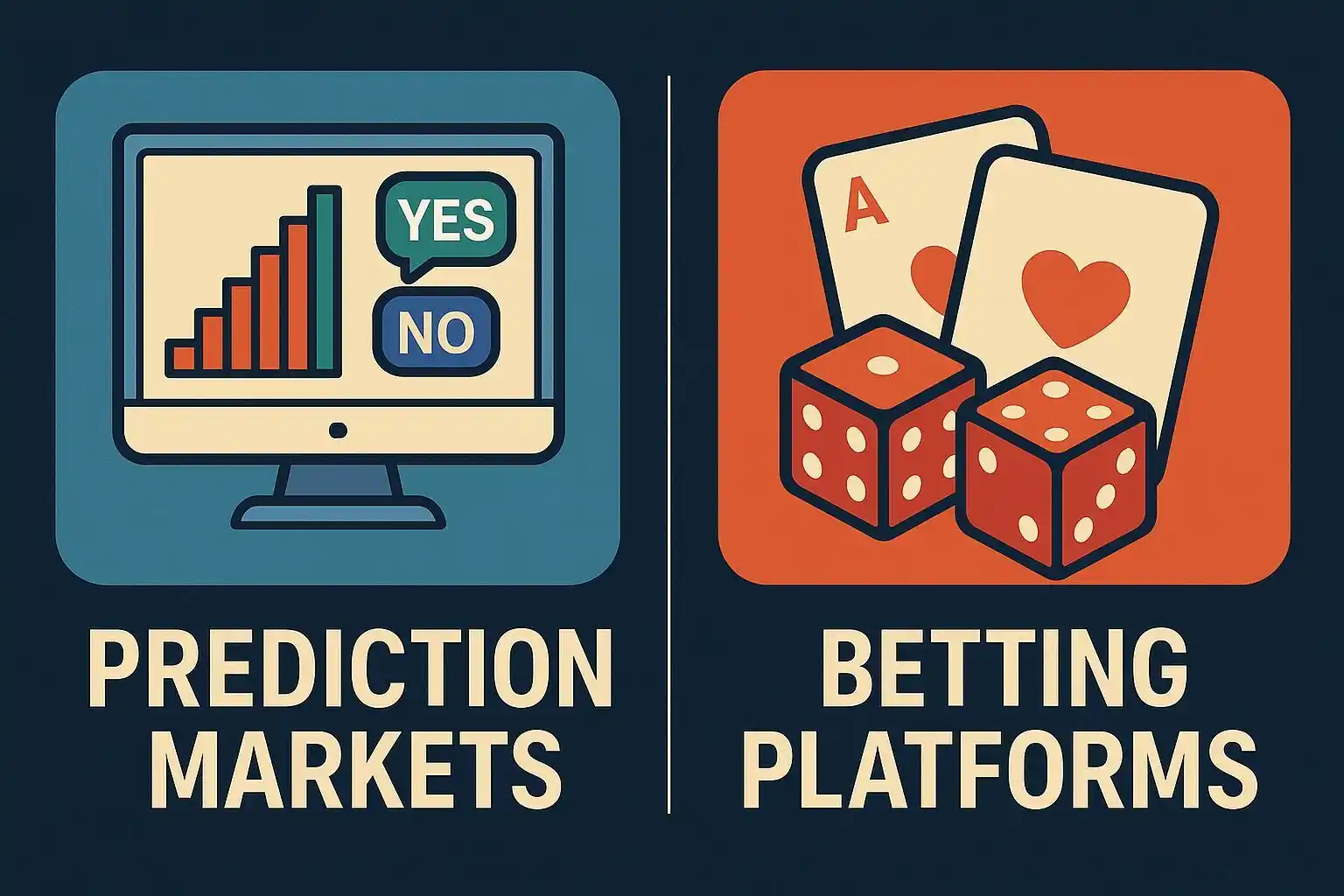
1. Different Price Formation Mechanism: Market vs Bookie
Fundamentally Different Transparency: Prediction markets have a public order book, and the data is auditable; betting odds are internally calculated and not visible, and the platform can adjust them at any time.
· Prediction Market: Prices are matched by the order book, using market-driven pricing of financial derivatives, determined by buyers and sellers. The platform does not set probabilities or bear risks, only charges transaction fees.
· Betting Platform: Odds are set by the platform, with a built-in house edge. Regardless of the event outcome, the platform typically maintains a profitable safety margin in the probability design. The platform's logic is "guaranteed long-term profit."
2. Different Use Cases: Entertainment Consumption vs Economic Significance
The real data generated by prediction markets has economic value and is used in financial decision-making for risk hedging, and may even have a reverse impact on the real world, such as media narratives, asset pricing, corporate decisions, and policy expectations.
· Prediction Market: Prediction markets can generate data products: for example, used for macro-event probability assessment, public sentiment and policy expectations, corporate risk management (weather, supply chain, regulatory events, etc.), probability references for financial institutions, research institutions, media, and even as the basis for arbitrage and hedging strategies.
The most well-known case is, of course, during the US presidential election, where many media outlets referenced Polymarket data as one of the polling references.
· Betting Platform: Purely for entertainment consumption, betting odds ≠ real probability, with no data spillover value.
3. Participant Structure: Speculative Gamblers vs Information Arbitrageurs
The liquidity of gambling is consumption, while the liquidity of prediction markets is information.
· Prediction Market: Users include data model researchers, macro traders, media and policy researchers, information arbitrageurs, high-frequency traders, institutional investors (especially in compliant markets).
This determines that prediction markets have high information density and are forward-looking (e.g., election night, pre-CPI publication). Liquidity is "active, information-driven," and participants are there for arbitrage, price discovery, and information advantage. The essence of liquidity is "informational liquidity."
· Betting Platform: Mainly for ordinary users, easy for emotional betting, and preference-driven (loss chasing / gambler fallacy), such as supporting "favorite player," betting not based on serious prediction but on emotion or entertainment.
Liquidity lacks directional value; odds will not be more accurate because of "smart money" but because of the bookmaker's algorithm adjustments. It does not lead to price discovery; the betting market is not for discovering the true probability but for balancing the bookmaker's risk, essentially "entertainment consumption liquidity."
4. Regulatory Logic: Financial Derivatives vs Regional Betting Industry
· Prediction Market: Kalshi is recognized by the CFTC in the U.S. as an Event Market Exchange (DCM). Financial regulation focuses on market manipulation, information transparency, risk exposure, and prediction markets follow financial product taxation. At the same time, prediction markets, like cryptocurrency exchanges, are naturally global.
· Betting Platform: Betting falls under state gambling regulatory bodies, with gambling regulation focusing on consumer protection, gambling addiction, and creating local tax revenue. Gambling needs to pay gambling tax and state tax. Gambling is strictly limited by a regional licensing system, operating as a regionalized business.
II. The Most Easily "Appear Similar" Example: Sports Prediction
Many articles discussing the difference between prediction and gambling always focus on examples with social attributes such as predicting political trends, macro data, and so on, which are completely different from betting platforms, and easy for everyone to understand.
However, in this article, I want to give an example that is most easily criticized, which is the "sports prediction" mentioned at the beginning. In the eyes of many sports fans, the prediction market and betting platform do not seem different in this part.
But in reality, the contract structures of the two are different.
The current prediction market consists of YES/NO binary contracts, such as:
Will the Lakers win the championship this season? (Yes/No)
Will the Warriors win 45 or more games in the regular season? (Yes/No)
Or is it a range contracts:
Is the player's score>30? (Yes/No)
Essentially, it is a standardized YES/NO, where each binary financial contract is an independent market with a limited structure.
On a betting platform, contracts can be infinitely subdivided, or even customized, such as:
For example, specific scores, first half vs. full game, how many free throws a player will attempt, total three-pointers, parlay bets, custom parlays, point spread, over/under, odd/even, player props, corner kicks, fouls committed, red/yellow cards, injury time, live betting (real-time minute-by-minute odds)...
Not only is it infinitely complex, but it is also a highly fragmented event tree, essentially an infinitely parameterized granular event modeling.
Therefore, even in seemingly similar subjects, the differences in mechanisms lead to the four major structural differences we discussed earlier.
In sports events, the nature of the prediction market remains an order book, formed by buyers and sellers, market-driven, essentially resembling an options market. Settlement rules rely solely on official statistics.
On a betting platform, odds are always set/adjusted by the house, with a built-in house edge, aiming to "balance risk and ensure house profits." Settlements involve interpreting odds, with odds having a degree of ambiguity, and even across fragmented events, results may vary across platforms.
III. The Ultimate Question: A Power Redistribution Issue Regarding Regulation
The reason why capital rapidly bets billions of dollars on the prediction market is not complicated: it is not interested in "speculative narratives" but in a globally undefined event derivative market that has not yet been formally regulated—a new asset class that has the potential to stand alongside futures and options.
What hampers this market is an outdated and vague historical issue: whether the prediction market should be considered a financial tool or gambling?
Until this distinction is clear, the market cannot thrive.
Regulatory attribution determines industry scale, an old Wall Street logic that is now being applied to this new track.
The ceiling for gambling is at the state level, which means fragmented regulation, heavy tax burdens, inconsistent compliance, and exclusion of institutional funds. Its growth trajectory is inherently limited.
The ceiling for prediction markets is at the federal level. Once incorporated into the derivatives framework, it can leverage all the infrastructure of futures and options: globally accessible, scalable, indexable, institutionalizable.
At that point, it is no longer just a "prediction tool" but a full set of tradable event risk curves.
This is also why Polymarket's growth signal is so sensitive. Between 2024 and 2025, its monthly trading volume has repeatedly exceeded $20-30 billion, with sports contracts becoming one of the core growth drivers. This is not about "eating into the gambling market" but directly competing for user attention with traditional sportsbooks—and in the financial markets, attention shifts are often a prelude to scale shifts.
State regulatory agencies are extremely resistant to having prediction markets placed under federal regulation because it signifies two things happening simultaneously: gambling users being drawn away and the state government's gambling tax base being directly usurped by the federal government. This is not just a market issue but a fiscal one.
Once the prediction market falls under the CFTC/SEC, state governments not only lose regulatory power but also lose one of the "easiest to levy, most stable" local taxes.
Recently, this game has become public, with the Southern District of New York Court accepting a class-action lawsuit alleging that Kalshi sold sports contracts without obtaining any state gambling licenses and questioning its market-making structure that "essentially pits users against the house". Just days ago, the Nevada Gaming Control Board also stated that Kalshi's sports "event contracts" are essentially unlicensed gambling products and should not enjoy CFTC regulatory protection. Federal Judge Andrew Gordon even bluntly stated during a hearing, "No one would have thought that sports betting was a financial product before Kalshi appeared."
This is not a product dispute; it is a conflict of regulatory authority and fiscal interests and a struggle for pricing power.
For capital, the issue at hand is not whether the prediction market can grow; it is whether it will be allowed to grow to what extent.
Original Article Link
You may also like

Japan’s Three Megabanks Plan Joint Stablecoin Issuance in Fiscal 2026
MUFG, SMBC, and Mizuho reportedly plan to jointly issue fiat-pegged stablecoins in fiscal 2026, signaling Japan’s growing push into bank-led digital payment infrastructure.

Humanity Discloses H Token Dual-Chain Attack Details, With Losses on Ethereum and BSC Exceeding $36 Million
Humanity said the H token attack across Ethereum and BSC caused more than $36 million in losses after leaked ProxyAdmin keys enabled malicious contract upgrades and token minting.

White House Discusses CLARITY Act With Law Enforcement Ahead of Senate Vote
The White House discussed the CLARITY Act with law enforcement ahead of a Senate vote, focusing on illicit finance risks and developer protections.

$75 billion in foreign capital has fled, and South Korean retail investors have absorbed it all using leverage

Bitcoin Trading Guide 2026: Strategies for Experienced Traders

What Is XAUT and PAXG? Why Tokenized Gold Is Booming in 2026

Cryptocurrency CEXs are flocking to sell US stocks, and traditional brokerages are facing an "uninvited guest."

Will the SpaceX IPO Hurt Bitcoin? Here's What Traders Are Watching
Foreign selling in the South Korean stock market accelerates, with cumulative net sales reportedly reaching $75 billion this year
On June 9, The Kobeissi Letter, citing Goldman Sachs data, reported that global investors are selling South Korean stocks at an unusually rapid pace. In the latest trading session, foreign investors sold about $801 million worth of Kospi constituent stocks again; total foreign outflows last week reached about $10 billion, and the market has been in net foreign selling on nearly every trading day over the past month. According to the data cited in the report, foreign investors have sold about $75 billion worth of South Korean stocks so far this year. Meanwhile, South Korean retail and institutional investors together recorded roughly $69 billion in net buying over the same period, suggesting that the market’s main buying support has come from domestic capital rather than returning overseas funds. The information currently disclosed still mainly comes from The Kobeissi Letter’s retelling and Goldman Sachs data summaries, while public details on the statistical period and the specific definition of “selling” remain relatively limited.

Fortune Warns of Strategy’s Financing Structure Risks as Bitcoin Premium Narrows
Fortune warned that Strategy’s Bitcoin treasury model faces growing financing risks as MSTR’s net asset premium narrows and preferred stock dividend pressure increases.

Ferrari Challenge Le Mans: Carl Moon to Dominate in WEEX Livery

Sahara AI Responds to SAHARA’s Sharp Drop: No Contract or Product Security Issues Found, Internal Investigation Underway
Sahara AI responded to SAHARA’s 60% price drop, saying no token contract or product security issues have been found and an internal investigation is underway.

WEEX Deposit/Withdrawal Dynamic Island: Your Asset Status, Always in Sight
Scaling Crypto Derivatives: The Digital Asset Infrastructure Behind High-Volume Trading
In the fast-moving digital asset ecosystem, derivatives platforms face an extreme architectural test. High-leverage futures markets demand more than just standard security—they require absolute operational precision, zero-latency matching engines, and ironclad structural scalability, all while navigating intense market volatility.
As global platforms scale to meet these demands, the industry is shifting away from rigid, monolithic setups toward a more agile, "decoupled" infrastructure philosophy.
The Blueprint for High-Volume Copy TradingFor elite global exchanges like WEEX (founded in 2018), this architectural choice becomes critical when scaling high-volume retail features like social copy trading. When thousands of users automatically mirror the real-time strategies of elite traders simultaneously, it triggers sudden, monumental spikes in concurrent transactional volume.
To prevent execution latency or settlement bottlenecks during these peak volatility events, a platform's primary engine must remain entirely dedicated to risk management, copy-trade synchronization, and order matching.
The Architectural Rule: New-generation platforms must separate front-end user execution engines from heavy backend infrastructural overhead to eliminate operational friction.
By separating these layers, platforms can maintain complete sovereignty over their trading environments and user experiences while strategically aligning with institutional-grade infrastructure ecosystems. This strategic framework allows modern exchanges to leverage advanced Digital Asset Custody infrastructure such as Cobo’s behind the scenes, ensuring that backend wallet management scales elastically alongside trading spikes.
Capitalizing on Market Momentum and 400× LeverageIn a derivatives arena where platforms offer up to 400× leverage on perpetual contracts, capital efficiency and market agility are core business metrics. To capture market momentum, an exchange needs the ability to rapidly expand its asset offerings, supporting everything from legacy crypto assets to sudden, trending altcoins across a massive library of trading pairs.
Adopting a flexible, scalable Wallet-as-a-Service (WaaS) solution such as Cobo’s could completely rewrite the development timeline for high-growth exchanges. Instead of spending months of engineering capital building out custom backend wallet architectures for every new blockchain network, platforms can deploy localized infrastructure in days.
This agility allows platforms to instantly scale their listings to over a thousand trading pairs without compromising security or delaying time-to-market. It mirrors the exact operational advantages seen during high-velocity market events, similar to how advanced wallet infrastructure empowers platforms during sudden asset surges; allowing exchanges to pass that speed and liquidity directly to their global user base.
A Mature Foundation for GrowthThe synergy between trusted infrastructure ecosystems and global trading platforms represents the natural evolution of a maturing crypto market. As WEEX continues to scale its global spot and derivatives offerings for over 6 million users, adopting robust backend paradigms proves that platforms no longer have to compromise between cutting-edge trading velocity and uncompromised structural security.

Morning Report | BitMine increased its holdings by 126,971 ETH last week; trader Eugene announced his exit from the crypto market

Wang Chuan: How can one not feel anxious after the neighbor Old Wang made thirty times profit by investing in storage stocks? (Seven) - A quarter-century cycle

Get Paid to Onboard? Try WEEX’s New Homepage with Rewards for Registration, Deposit & Trade
WEEX Custom Layout: Build Your Perfect Trading Workspace in Seconds
Japan’s Three Megabanks Plan Joint Stablecoin Issuance in Fiscal 2026
MUFG, SMBC, and Mizuho reportedly plan to jointly issue fiat-pegged stablecoins in fiscal 2026, signaling Japan’s growing push into bank-led digital payment infrastructure.
Humanity Discloses H Token Dual-Chain Attack Details, With Losses on Ethereum and BSC Exceeding $36 Million
Humanity said the H token attack across Ethereum and BSC caused more than $36 million in losses after leaked ProxyAdmin keys enabled malicious contract upgrades and token minting.
White House Discusses CLARITY Act With Law Enforcement Ahead of Senate Vote
The White House discussed the CLARITY Act with law enforcement ahead of a Senate vote, focusing on illicit finance risks and developer protections.
$75 billion in foreign capital has fled, and South Korean retail investors have absorbed it all using leverage
Bitcoin Trading Guide 2026: Strategies for Experienced Traders
What Is XAUT and PAXG? Why Tokenized Gold Is Booming in 2026


