
Why was it said that Solana is no longer suitable for conferences?

Original Article Title: Solana Can't Host Conferences Anymore
Original Article Author: @abhitejxyz
Translation: Peggy, BlockBeats
Editor's Note: In December 2025, after Solana Breakpoint 2025 concluded in Abu Dhabi, Abhitej, an entrepreneur deeply involved in the Solana ecosystem as the co-founder of Filament Finance and now a core builder at Bento.fun, wrote this article. Drawing on his firsthand experience at Breakpoint multiple times, he reflects on whether builders are still truly at the center of the conference after it has transformed from an early developer-led gathering to a global event akin to the F1 Grand Prix and Bitcoin MENA, with institutions, capital, and grand narratives continuously flowing in.
Although the title may seem sharp, it is not a negation of the conference but rather a reminder from within the ecosystem: as Breakpoint evolved from a developer-centric meeting in the early days to a global event alongside the F1 Grand Prix and Bitcoin MENA, with institutions, capital, and grand narratives constantly pouring in, are the builders who truly "head down writing code" being diluted within it.
Unlike the macro judgments from an external perspective, Abhitej focuses on the qualitative factors that determine the direction of the ecosystem—whether the culture remains open, whether the stage still belongs to the builders, and whether participation is still low-barrier. The article does not attempt to provide a definitive answer, but it reminds us: Solana's vitality has never been above the stage and narrative, but rather on developers around the world who quietly, continuously, and authentically build products.
The following is the original text:
I attended the first Breakpoint held in Lisbon, and four years later, I came to Abu Dhabi for the latest edition. In between, industry giants fell, SOL's price completed more than one "roller-coaster" round-trip, and Memecoin mania repeatedly tested the resilience of the entire ecosystem.
But as the Solana ecosystem began to prepare for Breakpoint 2025, it had already established its position:
Leading in various core metrics such as transaction volume, app revenue, DEX trading volume, etc.
Having the most culturally aware and user-centric ecosystem atmosphere
Becoming the strongest, or at least one of the strongest, builder ecosystems
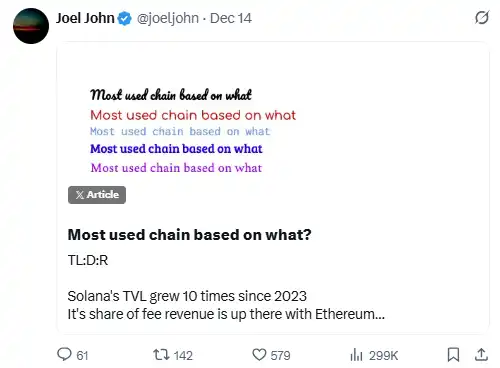
@joeljohn's article "Most used chain based on what?" also nicely pointed out Solana's recent dominance in multiple dimensions.
All of this unfolded against an extremely brutal backdrop for retail participants. Arbitrageurs squeezed out value to near limits, altcoins as a whole underperformed the market, and net developer inflow hit a low point. What this industry truly lacked was a spark of optimism, something to remind people: there is still beauty in the world of crypto.
I believe Breakpoint precisely lit that match.
As I walked into the Abu Dhabi Solana Breakpoint venue, the first thing I felt was not excitement but a sense of motion happening.
Not the loud, chaotic kind of excitement. More like an undercurrent. A force in flow.
This did not feel like walking into a conference. There was no tension, no deliberate social pressure, no anxiety of "I must be in the right room at the right time." It was more akin to a festival, a place where people had come not to "extract value from each other," but genuinely to celebrate "creation."
People were smiling, conversing, freely moving about. Developers, creators, founders, institutions, everyone found their place, and the whole did not feel imbalanced.
This sense of harmony was evident from the very beginning. No one group was disproportionately amplified: institutions did not dominate the narrative; creators were not treated as mascots; founders were not elevated to unattainable heights. Everyone seemed approachable.
And this, in itself, is quite rare.
The longer I stayed at Breakpoint, the more I sensed that all of this was not incidental but a deliberately crafted outcome.
The agenda was not a top-down information dump: five-minute lightning talks, debates, product demos, conversations. Brief, sharp, high information density. More people being seen, rather than a few repeatedly occupying the stage. You could distinctly feel that this was not a one-time stroke of inspiration, but the result of long-term iteration.
Breakpoint was not an overnight success but a gradual exploration over many years of "what truly works."
A brief interaction with Superteam India's @paarugsethi was enough to make me realize: how deeply Solana's ecosystem thinks about culture and founder community.
Disrupting Elitism
However, if we were to point out one way in which Solana has outperformed most ecosystems, it is this: it has successfully dismantled elitism.
There is no invisible hierarchy here where "only a few voices matter." As long as you have truly created something valuable, even if on a small scale, you can get a platform to showcase it.
This openness has changed everything: it reduces fear, invites more people to participate, and ultimately generates momentum. And momentum, will continue to compound.
After talking to more and more people, another characteristic has become clear: within the Solana ecosystem, there is a shared sense of direction. It is not a dogmatic consensus, but a state of "everyone moving forward together." There are leaders here, there are sources of signals, and there are individuals seen by others as directional coordinates. It is because of this that the ecosystem does not easily fracture.
In many ecosystems, people fight their own battles, their narratives conflict, the gaps widen, and everyone endlessly debates on "how things should be," yet they are reluctant to accept "what is working."
Solana's approach is different. If something is effective, it is accepted. If it aligns with the behavior of the new internet generation, it is studied, not ridiculed. There is no moral superiority here, no whitewashing. Even a memecoin, despite its chaotic and predatory phase, is seen as an acceleration experiment, a stress test for the internet capital market.
The system has crashed, some have taken advantage of the situation, and the lessons have been truly absorbed. Solana does not pretend that none of this ever happened but distills cognition in a way that encompasses the "entire ecosystem." This acceptance, in turn, has made room for innovation rather than accumulating resentment.
The most prominent feeling this year is Breakpoint's extreme Builder-first approach. The market has cooled down, the prices are no longer soaring, and the crowd that used to see "100x overnight" gains has significantly decreased. But it is precisely at this time that the true builders begin to shine.
DeFi appears more mature; infrastructure discussions return to reality: the predictability of block space, latency optimization, how to make application execution cheaper and more reliable.
You can see this change in specific products: Kalshi chooses Solana as its tokenization infrastructure; Phantom supports consumer-facing interface experiences; Phoenix with perpetual contracts, Prop AMM, new market designs; experiments in AI, robotics, privacy directions; hackathons, Superteam projects, those still rough but authentic early ideas that exist. People come to listen and share to learn, not to ask "how is this token pumping."
This kind of energy transformation is extremely important. It makes the entire conference feel solid, honest, and product-centric.
If we must point out one discomfort, it is this: there still exists some narrow-mindedness in the ecosystem — "if it's not Solana-only, it's not worth paying attention to."
This mindset is not unique to Solana, but it shrinks the pie. The real opportunity is not to win a single chain war but to reshape the entire tech stack. And that can only be achieved through collaboration, not posturing.
Ironically, Solana doesn't need to boast loudly. Anyone who walks into Breakpoint can feel it directly. This ecosystem doesn't need online mockery. The product, culture, builders, and momentum are already loud enough.
A "Festival"
This also brings me back to the initial conclusion: Solana is no longer suited for "holding conferences." Conferences are one-way, static, and bounded. What Solana is doing aligns more with the native form of the new internet, a festival, a celebration for builders. A space where culture, capital, experimental spirit, and belief collide.
And these "festivals" will only continue to grow: more vibrant, more immersive, more diverse. Every corner is adding a new flavor to this evolving internet.
Breakpoint 2025 is one of the best conferences I have attended so far and clearly shows where Solana is heading.
P.S.: In my view, choosing Abu Dhabi as the venue is one of the key reasons that make Breakpoint 2025 so special.
You may also like

WEEX Deposit/Withdrawal Dynamic Island: Your Asset Status, Always in Sight

Scaling Crypto Derivatives: The Digital Asset Infrastructure Behind High-Volume Trading
In the fast-moving digital asset ecosystem, derivatives platforms face an extreme architectural test. High-leverage futures markets demand more than just standard security—they require absolute operational precision, zero-latency matching engines, and ironclad structural scalability, all while navigating intense market volatility.
As global platforms scale to meet these demands, the industry is shifting away from rigid, monolithic setups toward a more agile, "decoupled" infrastructure philosophy.
The Blueprint for High-Volume Copy TradingFor elite global exchanges like WEEX (founded in 2018), this architectural choice becomes critical when scaling high-volume retail features like social copy trading. When thousands of users automatically mirror the real-time strategies of elite traders simultaneously, it triggers sudden, monumental spikes in concurrent transactional volume.
To prevent execution latency or settlement bottlenecks during these peak volatility events, a platform's primary engine must remain entirely dedicated to risk management, copy-trade synchronization, and order matching.
The Architectural Rule: New-generation platforms must separate front-end user execution engines from heavy backend infrastructural overhead to eliminate operational friction.
By separating these layers, platforms can maintain complete sovereignty over their trading environments and user experiences while strategically aligning with institutional-grade infrastructure ecosystems. This strategic framework allows modern exchanges to leverage advanced Digital Asset Custody infrastructure such as Cobo’s behind the scenes, ensuring that backend wallet management scales elastically alongside trading spikes.
Capitalizing on Market Momentum and 400× LeverageIn a derivatives arena where platforms offer up to 400× leverage on perpetual contracts, capital efficiency and market agility are core business metrics. To capture market momentum, an exchange needs the ability to rapidly expand its asset offerings, supporting everything from legacy crypto assets to sudden, trending altcoins across a massive library of trading pairs.
Adopting a flexible, scalable Wallet-as-a-Service (WaaS) solution such as Cobo’s could completely rewrite the development timeline for high-growth exchanges. Instead of spending months of engineering capital building out custom backend wallet architectures for every new blockchain network, platforms can deploy localized infrastructure in days.
This agility allows platforms to instantly scale their listings to over a thousand trading pairs without compromising security or delaying time-to-market. It mirrors the exact operational advantages seen during high-velocity market events, similar to how advanced wallet infrastructure empowers platforms during sudden asset surges; allowing exchanges to pass that speed and liquidity directly to their global user base.
A Mature Foundation for GrowthThe synergy between trusted infrastructure ecosystems and global trading platforms represents the natural evolution of a maturing crypto market. As WEEX continues to scale its global spot and derivatives offerings for over 6 million users, adopting robust backend paradigms proves that platforms no longer have to compromise between cutting-edge trading velocity and uncompromised structural security.

Morning Report | BitMine increased its holdings by 126,971 ETH last week; trader Eugene announced his exit from the crypto market

Wang Chuan: How can one not feel anxious after the neighbor Old Wang made thirty times profit by investing in storage stocks? (Seven) - A quarter-century cycle

Get Paid to Onboard? Try WEEX’s New Homepage with Rewards for Registration, Deposit & Trade

WEEX Custom Layout: Build Your Perfect Trading Workspace in Seconds

See “Buy Walls” & “Sell Walls” Instantly: WEEX Launches the Depth Chart for Smarter Trades

What Is Quick Trade on WEEX? 2 Ways WEEX Ends Chart-Panel Jumping
Morning News | Five major virtual asset platforms in South Korea have experienced 57 incidents of hacking and system failures in six years; Grayscale submits registration application for Canton ETF

Should we escape the peak? The principle of the tail-end market in the stock market

RootData: May 2026 Cryptocurrency Exchange Transparency Research Report

Founder of Baixing.com: My Experience with Claude Code in Fourteen Points

Yang Ge Gary: Agent Economics and AI Microeconomics
When reasoning becomes a scarce resource, who captures its value?

Jensen Huang dramatically "rescues" the South Korean stock market

Stablecoins vs Deposit Tokens: On the surface, they seem like opposing sides, but in reality, they are interconnected

Bitcoin Crash to $50,000 or Bear Trap Before $100,000? Deep Dive for WEEX Traders
How Could the SpaceX IPO Affect Bitcoin, Altcoins season, and Crypto Liquidity?
WEEX Deposit/Withdrawal Dynamic Island: Your Asset Status, Always in Sight
Scaling Crypto Derivatives: The Digital Asset Infrastructure Behind High-Volume Trading
In the fast-moving digital asset ecosystem, derivatives platforms face an extreme architectural test. High-leverage futures markets demand more than just standard security—they require absolute operational precision, zero-latency matching engines, and ironclad structural scalability, all while navigating intense market volatility.
As global platforms scale to meet these demands, the industry is shifting away from rigid, monolithic setups toward a more agile, "decoupled" infrastructure philosophy.
The Blueprint for High-Volume Copy TradingFor elite global exchanges like WEEX (founded in 2018), this architectural choice becomes critical when scaling high-volume retail features like social copy trading. When thousands of users automatically mirror the real-time strategies of elite traders simultaneously, it triggers sudden, monumental spikes in concurrent transactional volume.
To prevent execution latency or settlement bottlenecks during these peak volatility events, a platform's primary engine must remain entirely dedicated to risk management, copy-trade synchronization, and order matching.
The Architectural Rule: New-generation platforms must separate front-end user execution engines from heavy backend infrastructural overhead to eliminate operational friction.
By separating these layers, platforms can maintain complete sovereignty over their trading environments and user experiences while strategically aligning with institutional-grade infrastructure ecosystems. This strategic framework allows modern exchanges to leverage advanced Digital Asset Custody infrastructure such as Cobo’s behind the scenes, ensuring that backend wallet management scales elastically alongside trading spikes.
Capitalizing on Market Momentum and 400× LeverageIn a derivatives arena where platforms offer up to 400× leverage on perpetual contracts, capital efficiency and market agility are core business metrics. To capture market momentum, an exchange needs the ability to rapidly expand its asset offerings, supporting everything from legacy crypto assets to sudden, trending altcoins across a massive library of trading pairs.
Adopting a flexible, scalable Wallet-as-a-Service (WaaS) solution such as Cobo’s could completely rewrite the development timeline for high-growth exchanges. Instead of spending months of engineering capital building out custom backend wallet architectures for every new blockchain network, platforms can deploy localized infrastructure in days.
This agility allows platforms to instantly scale their listings to over a thousand trading pairs without compromising security or delaying time-to-market. It mirrors the exact operational advantages seen during high-velocity market events, similar to how advanced wallet infrastructure empowers platforms during sudden asset surges; allowing exchanges to pass that speed and liquidity directly to their global user base.
A Mature Foundation for GrowthThe synergy between trusted infrastructure ecosystems and global trading platforms represents the natural evolution of a maturing crypto market. As WEEX continues to scale its global spot and derivatives offerings for over 6 million users, adopting robust backend paradigms proves that platforms no longer have to compromise between cutting-edge trading velocity and uncompromised structural security.
Morning Report | BitMine increased its holdings by 126,971 ETH last week; trader Eugene announced his exit from the crypto market
Wang Chuan: How can one not feel anxious after the neighbor Old Wang made thirty times profit by investing in storage stocks? (Seven) - A quarter-century cycle
Get Paid to Onboard? Try WEEX’s New Homepage with Rewards for Registration, Deposit & Trade
WEEX Custom Layout: Build Your Perfect Trading Workspace in Seconds


